 Migraine Journal








Printable Migraine Calendar: A Whole Year on One Page (Free)
A free printable migraine calendar: a year-at-a-glance grid with three monthly totals, plus a month page with severity and a medication tick for each day.
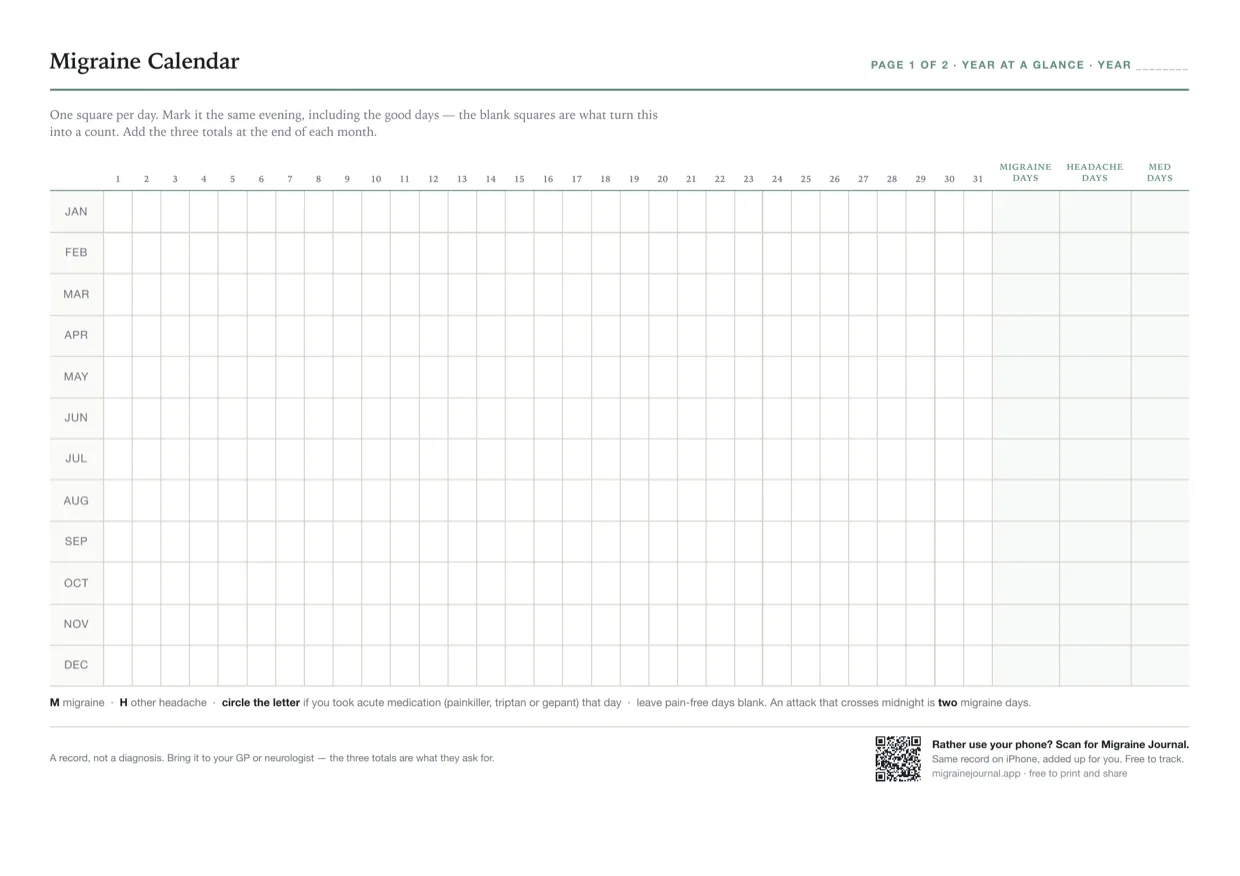
Download the printable migraine calendar (PDF, 2 pages, A4 landscape): free, no email required. Page 1 is a whole year; page 2 is a single month with more room.
On iPhone and would rather not print? Migraine Journal keeps this calendar for you: log an attack and the day fills itself in, tinted by severity, with the month’s migraine-day count above it. Free to track.
A migraine calendar has one job that a diary does badly: it shows how often. A doctor deciding between “keep going” and “time for a preventive” starts from a frequency, and the frequency is the number most people can’t produce when asked, because they remember attacks rather than days.
Page 1: the year, one letter per square
Twelve rows, one per month, 31 squares across. Each evening, one mark:
- M for a migraine day
- H for any other headache day
- blank for a pain-free day
- circle the letter if you took acute medication that day (a painkiller, a triptan or a gepant)
At the end of the month, add up three numbers in the shaded columns on the right: migraine days, all headache days, medication days.
That’s the whole system, and it’s deliberately thin. On a bad evening you can manage one letter. You cannot manage a form.
The blanks matter as much as the letters. A calendar where you only mark bad days looks the same as one you forgot about in week two, and when you come to add it up you won’t know which it is. Mark the square the same evening, even when the mark is nothing, by glancing at it and moving on.
The counting rule printed along the bottom
An attack that crosses midnight is two migraine days. A Wednesday-morning attack still going on Thursday puts an M on both squares.
This is the rule most people break, and it’s why the sheet states it rather than leaving it to a blog post. Clinicians, insurers and the classification itself work in days, not attacks. What counts as a migraine day covers the edge cases (the attack that starts at 11pm, the “is this one still going” morning) in more detail.
The three totals map onto the thresholds people get measured against. The ICHD-3 criteria for chronic migraine are headache on 15 or more days a month for more than three months, with at least 8 of those days having migraine features, which is why the calendar separates migraine days from all headache days instead of lumping them together. How many migraines a month counts as chronic walks through where the lines fall.
The medication column is there for a different threshold. The ICHD-3 criteria for medication-overuse headache are written in days of use per month: 15 or more for simple painkillers like paracetamol or ibuprofen, and 10 or more for triptans, ergots, opioids and combination painkillers, sustained for more than three months. A circled letter is one day, no matter how many tablets.
Page 2: one month, more room
For the months you want more detail, page 2 is a conventional Monday-to-Sunday grid. Each box has a corner for the date, a line for peak severity out of 10 and a medication tick box.
Its totals add one the year page doesn’t have: days missed or cut short. That’s the figure that carries weight at work and at school, and it’s the one a disability questionnaire like MIDAS asks about. Print one per month; it doesn’t replace page 1, which stays the master record.
Where paper works, and where the app does more
Paper is genuinely good at this. The year page fits on a fridge door, and the pattern you can see from across the kitchen, three Ms in a column on the same dates every month or a bad March, is something no phone screen shows as well.
The weak spot is the adding up. Twelve months of three totals is 36 sums, done at the end of a month when you may not feel like doing arithmetic, and the two-day rule is easy to forget in the moment.
Migraine Journal does that part automatically. Its History tab is this calendar: each migraine day is tinted by severity, days you check in as migraine-free get their own mark, and the header shows the month’s migraine-day count. If you log how long an attack lasted, a two-day attack lands on both dates without you thinking about it. The Meds tab counts the days you logged medication over the last 30, against the 15-day line. That is the simple-painkiller line, so if you take a triptan, read your count against 10 instead.
To be straight about the limits: the app has no separate “other headache” letter, so the H column is something paper does better. And the free version shows the last two months of calendar; looking back further, and a doctor report covering more than 30 days, are part of Plus. Logging itself is free and unlimited.
Print settings
Print at 100% scale on A4 landscape; it fits US Letter landscape with default margins. Black and white is fine. The shading only marks the total columns.
Put page 1 where you’ll see it every evening. A calendar on the fridge gets marked; one in a drawer gets reconstructed from memory at the end of the month, which is the version a doctor can’t use.
If a month’s totals start creeping up, the free printable migraine diary adds the detail behind each attack, and the medication log tracks the doses themselves. Every printable is at free downloads. The calendar is a record, not a diagnosis, so bring the totals to your GP or neurologist and let them decide what they mean.
Quick answers
What should a migraine calendar record?
One mark per day: M for a migraine day, H for any other headache, blank for pain-free. Circle the letter if you took acute medication. At the end of each month, write three totals: migraine days, all headache days and medication days.
Is a two-day attack one migraine day or two?
Two. A calendar counts days, not attacks, so an attack that crosses midnight puts a mark on both dates. The sheet prints the rule along the bottom because it is the one people most often get wrong.
Why count medication days separately?
Because overuse limits are written in days. ICHD-3 sets them at 15 or more days a month for simple painkillers and 10 or more for triptans, ergots, opioids and combination painkillers, sustained for more than three months.
How is a calendar different from a migraine diary?
A calendar answers how often, in seconds a day. A diary answers what happened, at the cost of a few minutes per attack. Many people keep the calendar daily and only add diary detail for the attacks that matter.
Or skip the printing
The sheet works on its own, and plenty of people never want anything else. The app records the same fields, plus the barometric-pressure change over the preceding 24 hours, which is the one column nobody can fill in from memory afterwards.
This article is general information, not medical advice. Talk to your GP or neurologist about your own symptoms, medication, and treatment.