 Migraine Journal








Headache Diary for Kids: Free Printable a Child Can Fill In
A free printable headache diary for kids: a week of day cards a child fills in with a 1–5 scale and drinks to colour, plus a page for the parent and doctor.
Download the kids’ headache diary (PDF, 2 pages): free, no email required. Page 1 is for your child and covers one week; print one a week. Page 2 is for you and covers the month.
On iPhone and would rather not print? A parent can keep this record on their own phone. Migraine Journal stamps the time the moment you log, which for a child’s short headaches is the detail that fades first, and turns the month into a report for the doctor. Free to track.
Adult migraine diaries don’t work for children. The scale runs to 10, which means nothing to a seven-year-old, the questions assume the child can describe the pain, and there’s nowhere to put the stomach ache that came instead of a headache. This diary is split in two: one page in your child’s words, one page in yours.
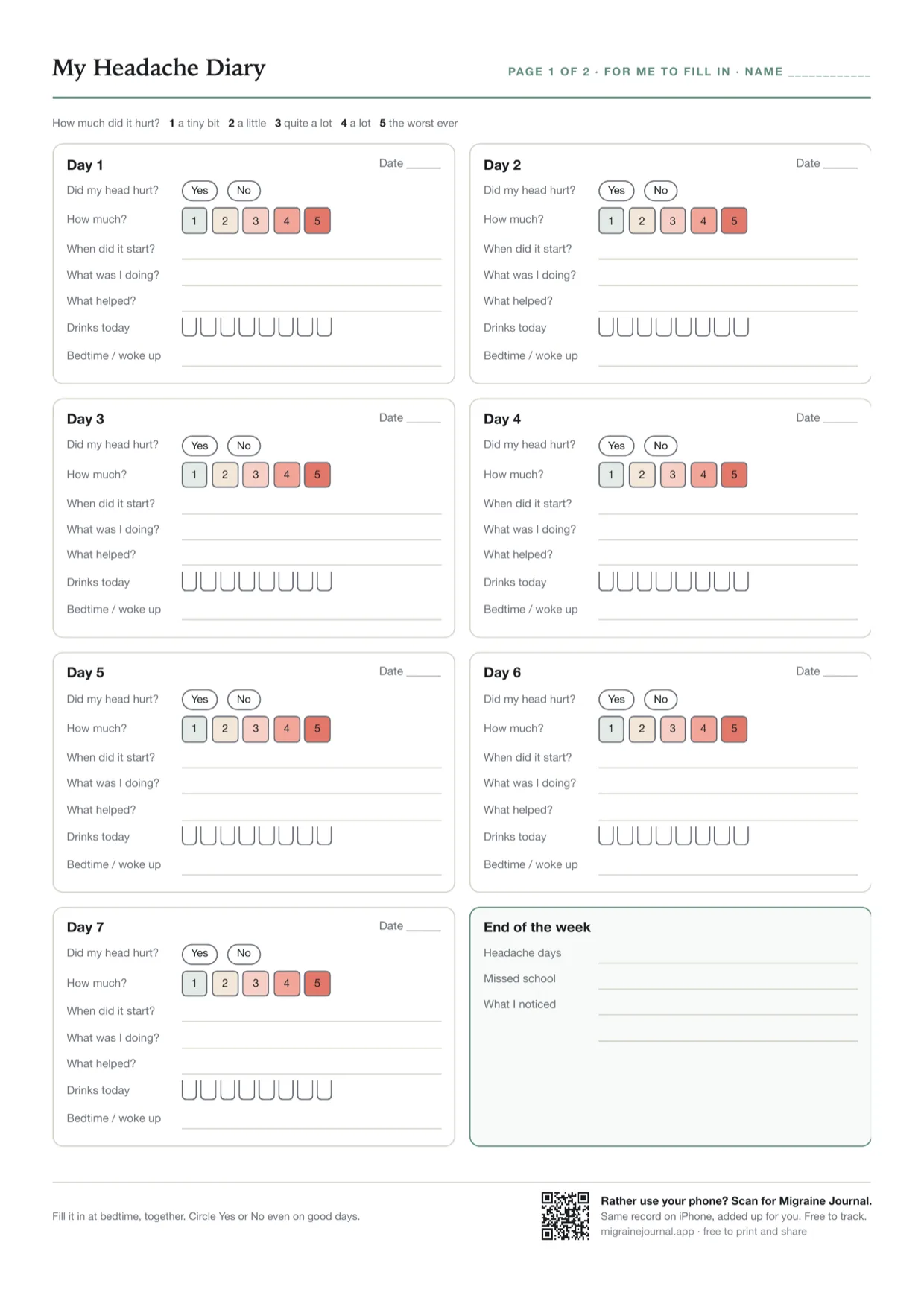
Page 1: written for the child
Seven day cards, one per day, each with the same short questions:
- Did my head hurt? Circle Yes or No.
- How much? Five boxes, shaded from pale to red, with words across the top of the page: 1 a tiny bit, 2 a little, 3 quite a lot, 4 a lot, 5 the worst ever. A child who can’t pick a number can usually point at a colour.
- When did it start? and What was I doing? One line each.
- What helped? A dark room, a sleep, a snack, medicine.
- Drinks today. Eight cup outlines to colour in.
- Bedtime / woke up.
The eighth card is the end of the week: headache days, missed school, and what I noticed, which is the child’s own guess about the cause, worth having even when it’s wrong.
The footer says it plainly: fill it in at bedtime, together, and circle Yes or No even on good days. The good days are what turn a list of bad days into a rate, and the rate is the first thing a GP or paediatrician needs.
The questions aren’t random. The National Migraine Centre calls a simple headache diary “a really useful tool both for diagnosis and management” in children, and suggests recording anything different from the normal routine, such as a missed meal or a late night, and scoring the pain. The Migraine Trust lists missed meals, low fluid intake and exercise among the things to watch, which is where the drinks row and “what was I doing?” come from.
Page 2: for the grown-up
Children describe pain differently, and their migraines often look different too. The National Migraine Centre notes that in children attacks are often shorter, sometimes under an hour, stomach pains are more frequent, and the headache itself may be minor or absent. So page 2 records what a child won’t think of as part of a headache:
Medicines given. Date, time, medicine and dose, and whether it helped after one to two hours.
Other symptoms. Feeling sick, tummy ache, dizziness, looking pale, written down even on days with no headache.
For the doctor, this month. Four boxes: headache days, school days missed or cut short, days a pain medicine was given, and what usually comes before one. Those four figures are what you’ll be asked for at the appointment, and they’re much harder to produce from memory than they sound. Signs of migraine in a young child covers what to look for in children too young to say what’s wrong.
The bottom of page 2 lists the situations where you should get urgent advice the same day: a sudden severe headache, one after a knock to the head, headache with fever and a stiff neck or rash, confusion or weakness, headaches that wake them or come with vomiting on waking, or headaches that are getting steadily more frequent or different. The NHS headaches page sets out when to call 111 and when to call 999 for a child, and when a migraine is an emergency goes through the same ground. If in doubt, call.
Paper or the app
Paper is the right choice for the child’s own page. A seven-year-old colouring in cups at bedtime is engaged in a way they won’t be watching a parent tap a phone, and their own answer to “what was I doing?” is often better than yours.
The parent’s page is where an app earns its place. If you’re logging for your child, Migraine Journal on your phone stamps the date and time the moment you log, so a short attack at school pick-up isn’t reconstructed at 9pm. You can record what they took and when, and mark later whether it helped. The calendar fills in by itself, and the doctor report covering the last 30 days is free to make: a PDF with the attack calendar, migraine days per month and average severity, to send ahead or hand over. Reports covering longer than 30 days are part of Plus.
Two honest limits. The app keeps one person’s record per Apple account, so if you have migraines too and already log your own, keep your child’s on paper rather than mixing the two. And its severity scale runs 0 to 10, so translate your child’s 1 to 5, or just use the notes. There’s no “missed school” field either; a word in the notes covers it, and the paper sheet has a box for it.
Print settings
Print at 100% on A4; it fits US Letter. Colour helps on page 1, since the shaded scale is part of how a child reads it, but black and white still works. Keep page 1 by the bed and page 2 wherever you keep the medicines.
If school is involved, the school migraine plan template is the letter and plan that goes alongside the diary, and teenagers who’ve outgrown the day cards can move to the free printable migraine diary. All the printables are at free downloads. The diary is a record, not a diagnosis; your child’s doctor decides what it means.
Quick answers
What should a child's headache diary include?
Whether their head hurt, how much on a simple scale, when it started, what they were doing, what helped, how much they drank and when they slept. A parent adds medicines given, other symptoms like tummy pain, and school days missed.
Can a young child fill in a headache diary?
With help, yes. Page 1 uses short questions and a five-point scale with words ('a tiny bit' to 'the worst ever') a young child can point to. Filling it in together at bedtime works better than asking about the day a week later.
Why record days without a headache?
Because a diary of bad days alone can't show how often headaches happen, and frequency is what the doctor needs. Circling No on a good day takes two seconds and turns the week into a rate.
Should tummy pain go in a headache diary?
Yes. Migraine in children often looks different from adult migraine, with stomach pain more frequent and headache sometimes minor or absent, so page 2 has a column for it even on days with no headache.
Or skip the printing
The sheet works on its own, and plenty of people never want anything else. The app records the same fields, plus the barometric-pressure change over the preceding 24 hours, which is the one column nobody can fill in from memory afterwards.
This article is general information, not medical advice. Talk to your GP or neurologist about your own symptoms, medication, and treatment.