 Migraine Journal
School Migraine Plan Template (Free Letter + Plan)
Two pages: a letter to send three days before the meeting, and a one-page plan the adult on duty in November can read in fifteen seconds.
Download the school letter and plan (PDF, 2 pages) — free, no email required. Page one is the letter you send ahead. Page two is the plan that gets pinned up.
Two pages because there are two readers, and they need opposite things.
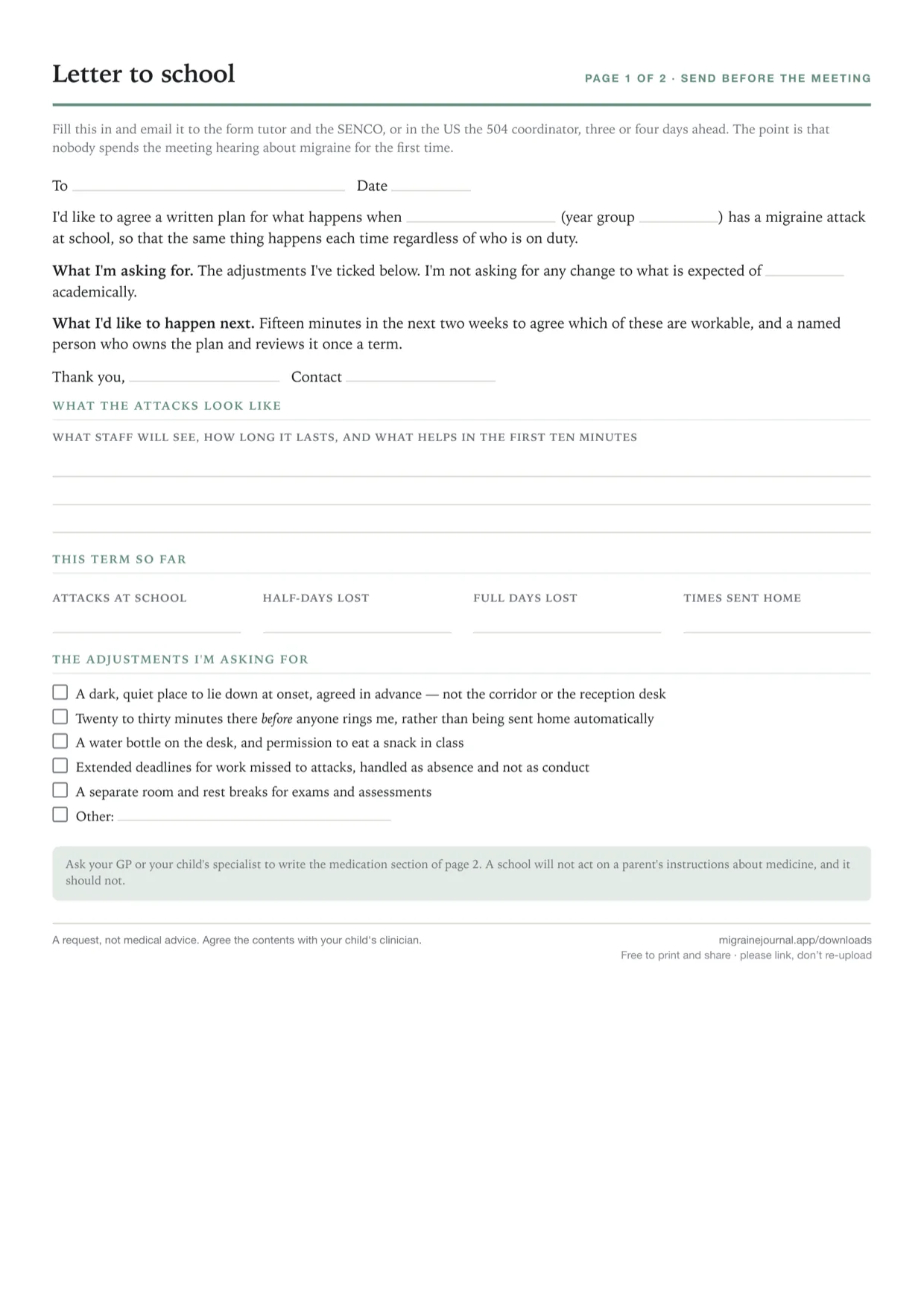
Page one: the letter, sent three or four days ahead
The reader here is the form tutor and the SENCO or 504 coordinator, sitting at a desk with time to read a paragraph.
The letter does four things. It names what your child’s attacks actually look like, so nobody is working from the word “headache”. It gives the term’s numbers — attacks at school, half-days lost, full days lost, times sent home — because numbers go into a document and get reviewed in March, while “she’s really been struggling” does not. It ticks the specific adjustments you are asking for. And it asks, in one sentence, for a written plan.
Sending it ahead is the part that changes the meeting. Walk in cold and the first twenty minutes go on explaining migraine to people hearing about it properly for the first time, which is twenty minutes you needed for the plan itself.
The numbers row is worth filling in even if you have to estimate. If you don’t have them, six weeks of a printable migraine diary will produce them, and the same rules apply as for any record meant to hold up later: write it down within the day, and record what you observed rather than what you concluded.
Page two: the plan, written for a stranger
The reader here is whoever is on duty on a wet Tuesday in November. They have fifteen seconds, they have never met your child, and they may be a supply teacher.
So page two is short, and it is written in instructions rather than explanations. What an attack looks like. What to do first. Where the child goes. Whether to call you, and at what point. What happens about missed work. Who owns the plan.
That last field matters more than it looks. A document with no named owner gets filed. A document with a name against it gets reviewed, and it will need reviewing, because the version you agree in September will be wrong by February.
The adjustment worth pushing hardest for
Not being automatically sent home.
Many children can head off an attack early and return to lessons, and a school policy of ringing the parent every time converts a manageable attack into a lost day plus missed content. Ask for the option of thirty minutes somewhere dark first, with the call as the fallback rather than the default.
The others on the tick-list: a dark, quiet place to lie down that is not the corridor and not the reception desk; water on the desk and permission to eat in class; extended deadlines so a lost week doesn’t arrive as a discipline problem; and a separate room with rest breaks for exams. The Migraine Trust’s guidance on how schools can help is the most useful list I have found, and sending the school its own copy carries more weight than a parent’s paraphrase.
Leave the medication section to a clinician
There is a box for it, and it is not for you to fill in.
Agree the wording with your GP or your child’s specialist and have it come from them. A school will not act on a parent’s written instructions about medicine, and it should not.
Ask for the plan by its name
In England, statutory guidance on supporting pupils at school with medical conditions expects an individual healthcare plan where a condition needs the school to put arrangements in place, and expects parents to contribute to it. Say “individual healthcare plan” and the SENCO knows how to answer. In the United States the equivalent artefact is a 504 plan. Rules differ by country and district, so check what applies where you are.
The full version of that conversation — including what to do when the answer is “we already do all this informally” — is in how to talk to your child’s school about migraines. If your child is old enough to be handling some of this themselves, how to help a teenager with migraines covers what to hand over and when.
Print settings
Print at 100% scale rather than “fit to page”. A4, prints fine on US Letter. Print page two twice: one for the school office, one for your fridge, so both sides are working from the same document.
Redo it once a year, or sooner if the pattern changes. What you are building is not a perfect description of your child’s migraine — it is the thing that stops you having this meeting again from the beginning. All six printables are at free downloads.
Quick answers
What should a school migraine plan contain?
What an attack looks like for your child, what staff should do first, whether they should be sent home or given a dark room for thirty minutes, who to call and when, and what to do about missed work. Medication wording comes from your GP, not from you.
Why send a letter before the meeting?
Because walking in cold means spending the first twenty minutes explaining migraine to people hearing it for the first time — twenty minutes you needed for the plan. Sent three days ahead, the school arrives having already thought about it.
What is this document called officially?
In England it feeds an individual healthcare plan, which statutory guidance expects where a condition needs the school to put arrangements in place. In the US the equivalent is a 504 plan. Asking for it by name changes the reply you get.
Who fills in the medication section?
Your GP or your child's specialist, with the wording agreed with them. A school will not act on a parent's instructions about medicine, and it should not.
Or skip the printing
The sheet works on its own, and plenty of people never want anything else. The app records the same fields, plus the barometric-pressure change over the preceding 24 hours, which is the one column nobody can fill in from memory afterwards.
This article is general information, not medical advice. Talk to your GP or neurologist about your own symptoms, medication, and treatment.