 Migraine Journal








Migraine Medication Log: Free Printable With the Overuse Limits
A free printable migraine medication log: one line per dose with pain before and two hours later, a tick strip for medication days, and a preventive history.

Download the migraine medication log (PDF, 2 pages): free, no email required. Print a fresh page 1 each month. Page 2 is a running list you keep for years.
On iPhone and would rather not print? Migraine Journal has a Meds tab that counts your medication days for you: every dose you log with an attack is time-stamped, and the tab shows how many of the last 30 days you took something. Free to track.
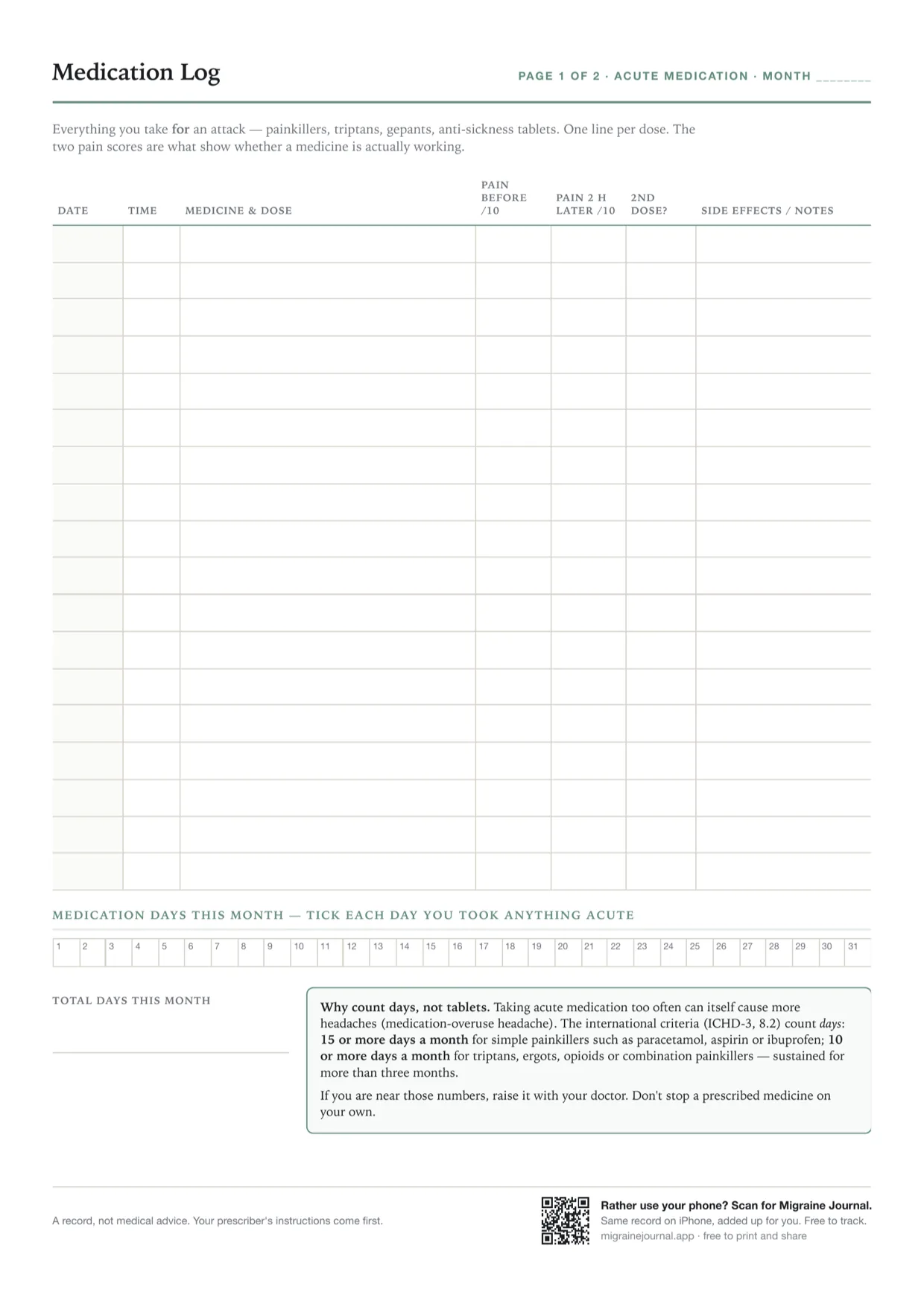
Most medication trackers are built to remind you to take a pill. A migraine medication log has the opposite job: it records the pills you took for an attack so you can see two things a reminder app never shows. One is whether a medicine is actually working. The other is whether you are taking acute medication often enough for it to become part of the problem.
Page 1: one line per dose
Each row is a single dose of anything you take for an attack: painkillers, triptans, gepants, anti-sickness tablets. The columns:
Date and time. The time matters more than people expect. A triptan taken 45 minutes into an attack and one taken after five hours are different experiments, and “when did you take it?” is one of the first questions a doctor asks about a medicine that “doesn’t work”.
Medicine and dose. Write the strength from the packet, not just the name. The same drug at two strengths is two different trials, and a log that only says the name can’t tell them apart.
Pain before, and pain two hours later, both out of 10. These two columns are the reason the sheet exists. Two hours is the checkpoint clinical trials use to judge an acute migraine treatment (International Headache Society trial guidelines), and writing both numbers at a fixed time turns “it took the edge off” into a 7 going to a 3. After ten rows you can see whether that’s typical or a lucky run.
Second dose? A dose that needs a second dose is information. So is one that needed a different medicine on top.
Side effects and notes. Tight chest, drowsy, sick: the things that make you avoid a medicine without ever telling anyone why.
The tick strip, and why it counts days
Under the table is a strip numbered 1 to 31. Tick each day you took anything acute, then write the total.
That strip is the overuse check. Taking acute medication too often can itself cause more headaches, and the ICHD-3 criteria for medication-overuse headache measure it in days per month, not doses:
- 15 or more days a month for simple painkillers: paracetamol, aspirin, ibuprofen and other anti-inflammatories
- 10 or more days a month for triptans, ergots, opioids and combination painkillers (for example, ones containing codeine or caffeine)
- sustained for more than three months
There is a fourth line the sheet doesn’t have room for: ICHD-3 also counts a mix of classes on 10 or more days in total, even when no single drug crosses its own line. That’s why the strip counts any acute medicine, not each one separately.
Three tablets on one day is one tick. Which line is yours depends on what you take, and medication overuse headache: how many days goes through the arithmetic. If the total is getting close, that’s a conversation with your doctor. Don’t stop a prescribed medicine on your own.
Page 2: the preventive history
The back page is a different kind of record. It lists every preventive you’ve tried, including the failures: the medicine, the highest dose you reached, when you started and stopped, why you stopped (side effects, no change, something else), and your migraine days per month before and while on it.
This is the list specialists and insurers ask for before newer treatments, and it’s the hardest one to rebuild from memory. “I tried something for a while years ago and it made me tired” doesn’t count as a trial on a prior-authorisation form. A row with the name, the dose reached, four months, “stopped for fatigue” and “9 migraine days a month before, 8 on it” does. Many US plans still require failed preventives before they cover a CGRP treatment, and what a prior authorisation needs from your diary explains why that last column carries so much weight.
The sheet notes that most preventives need two to three months at a full dose before they can be judged. How long before a migraine preventive works has the American Headache Society’s figures, including why the clock starts at the target dose rather than the first tablet, and it’s the main reason the “started” and “stopped” dates are worth writing down. Below the table are two boxes for allergies and medicines that didn’t suit you, and for other regular medicines and supplements.
Paper or the app: what each does better
The paper log is better at two things. It records a pain score at two hours as a habit, and it holds the preventive history, which Migraine Journal doesn’t track: the app logs medicines you take during an attack, not daily preventives.
The app is better at the counting. Each dose you add to an attack gets its time stamped, and medicines you’ve used before come up as one-tap pills, so “Sumatriptan 50mg” stays one row instead of three spellings. The Meds tab shows how many of the last 30 days you took anything, with your most-used medicines underneath. That count is free. It’s measured against the 15-day line, so if you take triptans, read it against 10. You can also mark each dose as helped or didn’t help for free. Seeing which medicine helps most often, as a percentage, is part of Plus, and so is the month-by-month medication chart in the doctor report.
One honest gap: the app only counts medicine you log alongside an attack. A painkiller for a non-migraine headache needs logging too, or the count comes out low. Whichever you use, it is a record, not medical advice, and your prescriber’s instructions come first.
Print settings
Print at 100% on A4; it fits US Letter. Keep page 1 wherever the medicines live, since a log next to the packet gets filled in and a log in another room gets filled in from memory. Page 2 belongs in the folder you take to appointments, alongside the free printable migraine diary. All the printables are at free downloads.
Quick answers
What should a migraine medication log record?
For each acute dose: the date, the time, the medicine and dose, pain out of ten before taking it and again two hours later, whether you needed a second dose, and any side effects. Separately, a tick for each day of the month you took anything.
Why count medication days instead of tablets?
Because the overuse limits are written in days. ICHD-3 counts 15 or more days a month for simple painkillers and 10 or more for triptans, ergots, opioids or combination painkillers, sustained for more than three months. Three tablets on one day is one day.
Why score the pain two hours after a dose?
Two hours is the standard checkpoint for whether an acute migraine treatment worked; it is the time point used in clinical trials. Before-and-after scores at a fixed time make doses comparable in a way that 'it sort of helped' never does.
Should I keep a list of preventives I've stopped?
Yes. Specialists and insurers ask which preventives you tried, the dose you reached, for how long, and why you stopped. It is the hardest list to rebuild from memory, and page 2 of the log exists to hold it.
Or skip the printing
The sheet works on its own, and plenty of people never want anything else. The app records the same fields, plus the barometric-pressure change over the preceding 24 hours, which is the one column nobody can fill in from memory afterwards.
This article is general information, not medical advice. Talk to your GP or neurologist about your own symptoms, medication, and treatment.