 Migraine Journal








Migraine Diary Example: One Filled-In Week, Line by Line
A migraine diary example: one made-up week filled in on the free diary's columns, with a note on why each entry is written that way, and what it adds up to.

Download the migraine diary example (PDF, 1 page): free, no email required. It’s a filled-in week to read; when you’re ready to start, the blank migraine diary has the same columns.
On iPhone and would rather not print? Migraine Journal does the adding-up this example shows by hand: it counts a two-day attack as two migraine days, totals your medication days, and builds the summary as a PDF. Free to track.
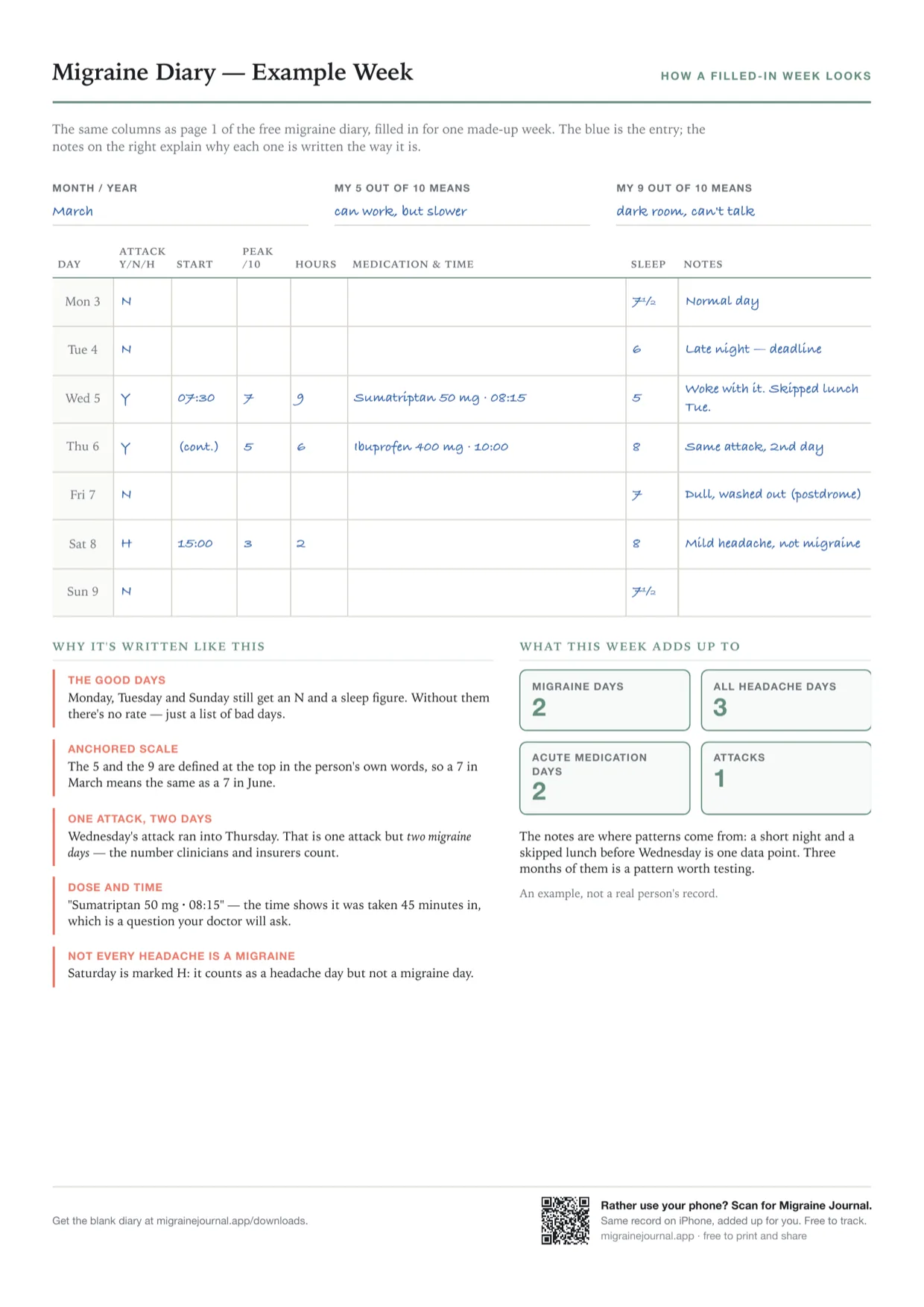
Most people who search for a migraine diary example already have a blank template. What they’re missing is what a good entry looks like: how much to write, what to do on a clear day, and how a two-day attack goes down on the page. This sheet is one invented week, filled in on the same columns as page 1 of the free printable migraine diary, with a note next to each entry explaining it.
It is an example, not a real person’s record.
The two lines above the grid
Before any day is filled in, the top of the page says what this person’s numbers mean:
- My 5 out of 10 means: can work, but slower
- My 9 out of 10 means: dark room, can’t talk
That’s the step almost everyone skips, and it’s what stops the scale drifting. Without it, a 7 in March and a 7 in June aren’t the same 7; once you’ve had a worse attack, the old 7s quietly become 5s and any trend you try to read is an artefact. Two anchors in your own words fix it.
The week, row by row
| Day | Entry | Why it’s written like that |
|---|---|---|
| Mon 3 | N · sleep 7½ · “Normal day” | A clear day still gets a letter and a sleep figure. |
| Tue 4 | N · sleep 6 · “Late night — deadline” | Nothing happened yet, but the note is the one that will matter tomorrow. |
| Wed 5 | Y · 07:30 · peak 7 · 9 h · sumatriptan 50 mg at 08:15 · sleep 5 · “Woke with it. Skipped lunch Tue.” | Start time, dose and time taken. |
| Thu 6 | Y · (cont.) · peak 5 · 6 h · ibuprofen 400 mg at 10:00 · sleep 8 · “Same attack, 2nd day” | Same attack, second date. |
| Fri 7 | N · sleep 7 · “Dull, washed out (postdrome)” | No pain, but not a normal day either. |
| Sat 8 | H · 15:00 · peak 3 · 2 h · sleep 8 · “Mild headache, not migraine” | A headache day, not a migraine day. |
| Sun 9 | N · sleep 7½ | The shortest possible entry, and still worth writing. |
Five things in that week are worth copying.
The good days are filled in. Monday, Tuesday and Sunday each get an N and a sleep figure. Without them there’s no rate, just a list of bad days, and a list can’t tell you whether things are getting better.
One attack, two migraine days. Wednesday’s attack ran into Thursday. That’s one attack but two migraine days, and days are what clinicians and insurers count. What counts as a migraine day explains why that rule moves people across thresholds.
Dose and time, not just the drug. “Sumatriptan 50 mg · 08:15” against a 07:30 start shows it was taken 45 minutes in. If a medicine seems not to work, “when did you take it?” is one of the first questions your doctor will ask, and this row answers it.
Not every headache is a migraine. Saturday is marked H. It counts toward all headache days but not migraine days, and both totals get asked for.
Friday is written down. No pain, but “dull, washed out” is the day after an attack, and the postdrome is part of the cost of a migraine that a pain-only diary misses.
What the week adds up to
The four boxes on the right of the sheet are the point:
- Migraine days: 2 (Wednesday, Thursday)
- All headache days: 3 (plus Saturday)
- Acute medication days: 2 (Wednesday, Thursday)
- Attacks: 1
Those are the figures a GP or neurologist works from, and what to record in a headache diary for a neurologist covers why each one matters. Medication days get their own box because the ICHD-3 medication-overuse criteria are written in days per month, not tablets.
The notes column is where patterns come from. A short night and a skipped lunch before Wednesday is one data point. The Migraine Trust suggests keeping a diary for three months or more before reading anything into it, and a single week, even a well-kept one, proves nothing about triggers.
Doing the adding-up by hand, or not
The example makes the counting look easy because it’s one week. Across a month it’s thirty rows, a rule about attacks that cross midnight, and a separate count for medication, done at the end of the month when you least want to do sums.
That’s the part Migraine Journal takes off your hands. Log the attack with the time it started, the severity and what you took and when, and the app does Wednesday-into-Thursday for you: an attack with a logged duration lands on every date it covered, and the History calendar shows the month’s migraine-day count. The Meds tab counts medication days over the last 30. The free doctor report turns the last 30 days into a PDF of the same summary, with an attack calendar and migraine days per month, and barometric pressure is recorded automatically each time you log.
Where paper still wins: the app has no H for a non-migraine headache, and the two anchor lines at the top of this sheet are something you’d keep in your head, or in the notes. Logging is free and unlimited. Reports over longer ranges and the pattern insights are part of Plus.
Using the example
Print it once and keep it next to your blank diary for the first couple of weeks, until the format is automatic. Then throw it away; the habit is what matters. The blank diary, the calendar, the medication log and the rest are all at free downloads. The example shows how to keep a record, not how to read one, and what your own record means is a conversation for your GP or neurologist.
Quick answers
What does a good migraine diary entry look like?
Short and consistent: whether there was an attack, start time, peak severity out of ten, hours it lasted, the medicine with its dose and the time taken, hours slept, and a few words of notes. A clear day gets an N and a sleep figure.
How do you count a migraine that lasts two days?
As one attack but two migraine days. In the example, Wednesday's attack runs into Thursday, so the week shows one attack and two migraine days, which is the figure clinicians and insurers count.
Should a migraine diary include headaches that aren't migraines?
Yes, marked differently. The example uses H for Saturday's mild headache, so it counts toward all headache days but not migraine days. Both totals are asked for, and they answer different questions.
Why write the time a medicine was taken?
Because when it was taken is part of whether it worked. In the example, the triptan was taken 45 minutes after the attack started, a gap your doctor will ask about if a medicine seems not to be helping.
Or skip the printing
The sheet works on its own, and plenty of people never want anything else. The app records the same fields, plus the barometric-pressure change over the preceding 24 hours, which is the one column nobody can fill in from memory afterwards.
This article is general information, not medical advice. Talk to your GP or neurologist about your own symptoms, medication, and treatment.