 Migraine Journal








Menstrual Migraine Tracker: Free Printable for Three Cycles
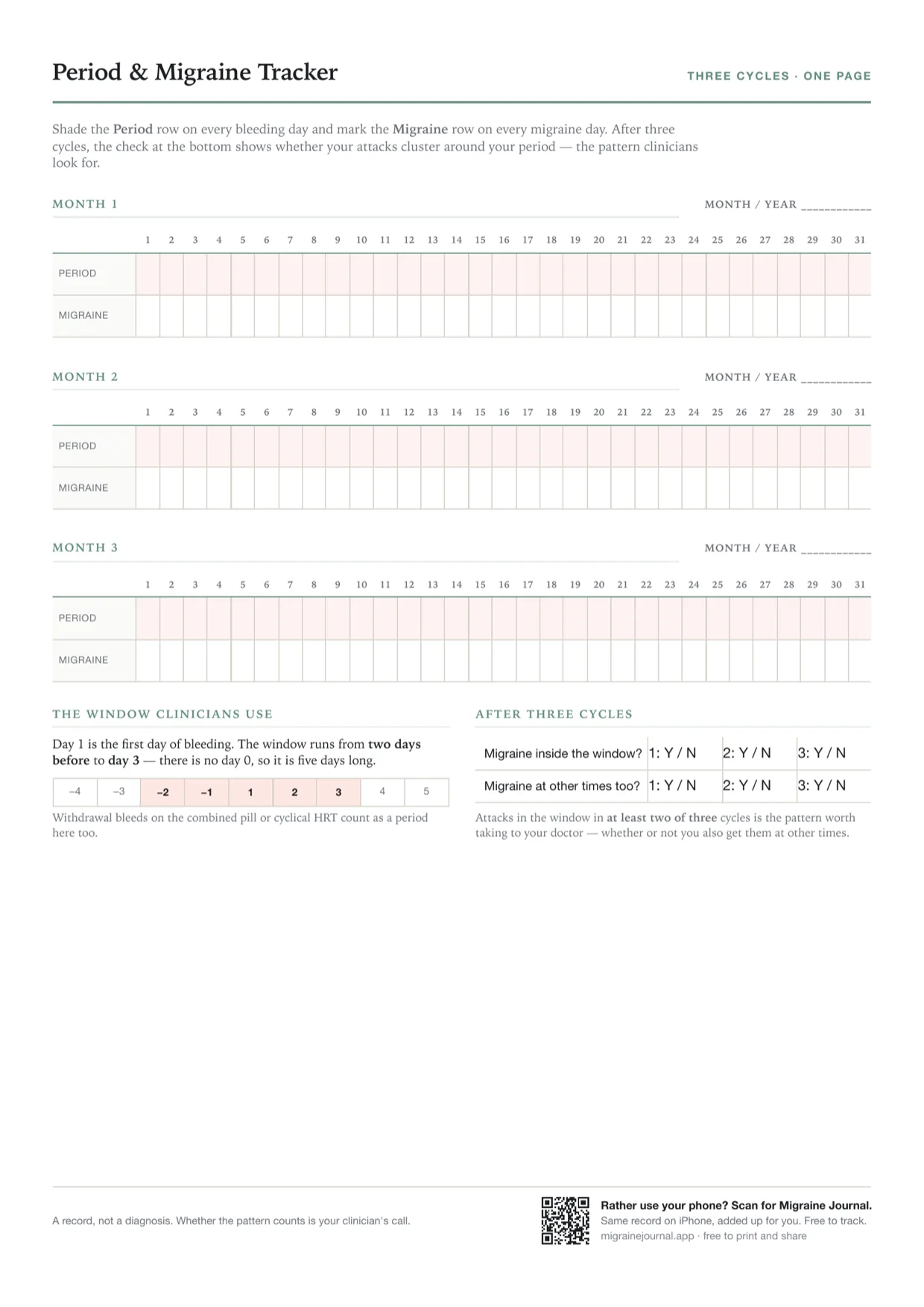
A free one-page menstrual migraine tracker: period and migraine rows for three months, the day −2 to +3 window drawn out, and the two-of-three-cycles check.

Download the period and migraine tracker (PDF, 1 page): free, no email required. One sheet covers three cycles, which is the minimum the question needs.
On iPhone and would rather not print? Migraine Journal logs the migraine half of this sheet for you, with dates and times stamped as you log, and you can tag an attack with the Hormonal cycle trigger or note your cycle day alongside it. Free to track.
Whether your migraines are tied to your period isn’t decided by how the attacks feel. It comes down to their dates. Period apps record the bleeding, and migraine diaries record the attacks. This sheet puts both on the same pair of rows so you can see in one look whether they line up.
Two rows a month, three months a page
Each month block has a Period row and a Migraine row, both numbered 1 to 31 by calendar date.
- Shade the Period square on every day of bleeding.
- Mark the Migraine square on every migraine day. An attack that runs over two dates gets two marks.
- Write the month and year in the corner of each block.
That’s all you do during the month. Calendar dates instead of cycle days is deliberate: you don’t need to know where you are in your cycle to fill it in, you only need to know today’s date.
The window, drawn out
The bottom-left panel draws the window clinicians use. Day 1 is the first day of bleeding. The window runs from two days before day 1 to day 3, and because there is no day 0 (the day before day 1 is day −1), it’s five days long: −2, −1, 1, 2, 3.
That definition comes straight from the ICHD-3 appendix criteria for pure menstrual migraine, which write it as “day 1 ± 2 (ie, days −2 to +3)”. The missing day 0 is the detail most people get wrong when they count it themselves, and it’s why the strip on the sheet skips from −1 straight to 1.
Withdrawal bleeds count. ICHD-3 treats bleeding from withdrawal of progestogens, as on the combined pill or cyclical HRT, as menstruation for this purpose. Shade those days on the Period row like any other.
To check a cycle, find the first shaded Period square, count two squares back and three forward (day 1 included), and look for a migraine mark in those five. If your period starts on the 1st or 2nd, the first two days of the window are at the end of the previous month’s row, which is one reason the sheet keeps three months stacked together.
The check after three cycles
The bottom-right table asks two questions for each of the three cycles:
- Migraine inside the window? Y or N.
- Migraine at other times too? Y or N.
The pattern worth taking to your doctor is a Y in the first row for at least two of the three cycles. That’s the “two out of three” in the ICHD-3 criteria, and The Migraine Trust gives the same rule, along with keeping a diary of attacks and period days for at least three months.
The second row separates the two patterns ICHD-3 describes. Window attacks only is pure menstrual migraine; window attacks plus attacks at other times is menstrually-related migraine. A Y in both rows doesn’t weaken the pattern. It just means it’s the second kind.
How to tell if your migraines are hormonal explains why this counting method works where symptom checklists can’t, and menstrual migraine: what helps covers what people do once the pattern shows up. Whether it counts is your clinician’s call, and the sheet is what you bring them.
Paper or the app: which half each does better
This is one of the printables where paper is the stronger tool for the core job, and it’s fair to say so. Migraine Journal doesn’t have a period row, so it can’t line your bleeding days up against the window for you.
What it does is the half people lose: the migraine dates. Every attack is stamped with the date and time when you log it, an attack you log with a duration lands on every day it covered, and the History calendar shows each migraine day at a glance. Tag an attack with the Hormonal cycle trigger, or write “day 2” in its notes, and the free Insights tab counts how often that tag comes up in your top triggers. Testing whether a trigger actually lines up with more attacks is part of Plus.
A good combination is the app for the attacks and this sheet on the bathroom shelf for the bleeding days, transferred once a month. If you already use a period app, the dates you need are in it; you only need to copy them across.
Print settings
Print at 100% on A4; it fits US Letter. Black and white works, and the pink tint on the Period row is there for guidance only. Keep it somewhere you’ll see daily for three months. Paper diaries usually fail in the second month, not the first.
For the rest of what’s going on during those months (sleep, medication, the detail of each attack), the free printable migraine diary sits alongside it. All the printables are at free downloads.
Quick answers
How many cycles do you need to track for menstrual migraine?
At least three. The ICHD-3 appendix criteria look for attacks in the window in at least two out of three cycles, and The Migraine Trust suggests keeping a diary of attacks and period days for at least three months.
What is the menstrual migraine window?
Day 1 ± 2: from two days before the first day of bleeding to the third day of bleeding. Day 1 is the first day of bleeding, the day before it is day −1, and there is no day 0, so the window is five days long.
Does a withdrawal bleed on the pill count as a period?
For this purpose, yes. ICHD-3 counts bleeding from withdrawal of progestogens, as on the combined pill or cyclical HRT, as menstruation, so mark those bleeds on the Period row too.
What if I also get migraines at other times of the month?
That is common and still counts. ICHD-3 separates pure menstrual migraine, with attacks only in the window, from menstrually-related migraine, with window attacks plus attacks at other times. The sheet asks both questions for each cycle.
Or skip the printing
The sheet works on its own, and plenty of people never want anything else. The app records the same fields, plus the barometric-pressure change over the preceding 24 hours, which is the one column nobody can fill in from memory afterwards.
This article is general information, not medical advice. Talk to your GP or neurologist about your own symptoms, medication, and treatment.