 Migraine Journal
What to Bring to a Neurologist Appointment for Migraine
A neurologist needs four numbers, not your life story. What to bring to a neurologist appointment for migraine, and why one page beats a 40-page printout.

Bring four numbers, one page, and your medication history. Migraine days per month, total headache days per month, how many days a month you take acute medication, and a disability score. Everything else is supporting material.
A first neurologist appointment often runs 20 to 30 minutes, and follow-ups are shorter. Most of that time gets spent establishing those four figures. Arrive with them and you convert an information-gathering session into a treatment conversation. If you do not have the appointment yet, how to get referred to a headache specialist is the step before this one.
The four numbers
Migraine days per month. Days with a migraine attack, not number of attacks. An attack spanning Tuesday evening into Wednesday afternoon is two migraine days. This distinction matters because the thresholds that define chronic migraine are counted in days.
Total headache days per month. All head pain, including the ordinary ones. Many people only count the bad days, which understates the picture.
Acute medication days per month. How many days you take something to stop an attack, counted per drug type. Clinicians ask about this at every appointment because taking acute medication frequently over months can itself worsen headache frequency — a recognised phenomenon with its own diagnostic criteria. This is a question about pattern rather than a judgement, and under-reporting it is the most counterproductive thing you can do in the room.
A disability score. More on this below.
Bring these as an average over the last three months. If you have longer, say so.
If what you were asked for was a diary rather than a summary, what to record in a headache diary for a neurologist covers the daily fields these four figures are built out of, and the ones that only add noise.
Use a validated disability score
“It’s been really bad lately” is not comparable across visits. A score is.
Two instruments are standard. MIDAS asks five questions about days lost to headache across work, household, and social activity over the previous three months; it was designed specifically to improve communication between patients and clinicians and to help match treatment intensity to disease severity (Stewart et al.). HIT-6 is six questions covering pain, social and role functioning, energy, concentration, and mood, and is routinely used as a valid measure of headache-related disability.
Either takes two minutes. Score yourself before the appointment, and keep the score, because the change between visits is the real signal. A treatment that reduces your HIT-6 by eight points has done something, whether or not the attacks feel different in the moment.
Migraine Journal includes both assessments and keeps the history, so you can see the trend rather than a single reading.
The one-page summary
Write it on paper. Not a phone screen you’ll have to scroll while talking.
If you’d rather not build it from scratch, the appointment prep sheet is free and already laid out — the four figures, a treatment-history table, the questions below, and a box to write down what was decided before you leave the building.
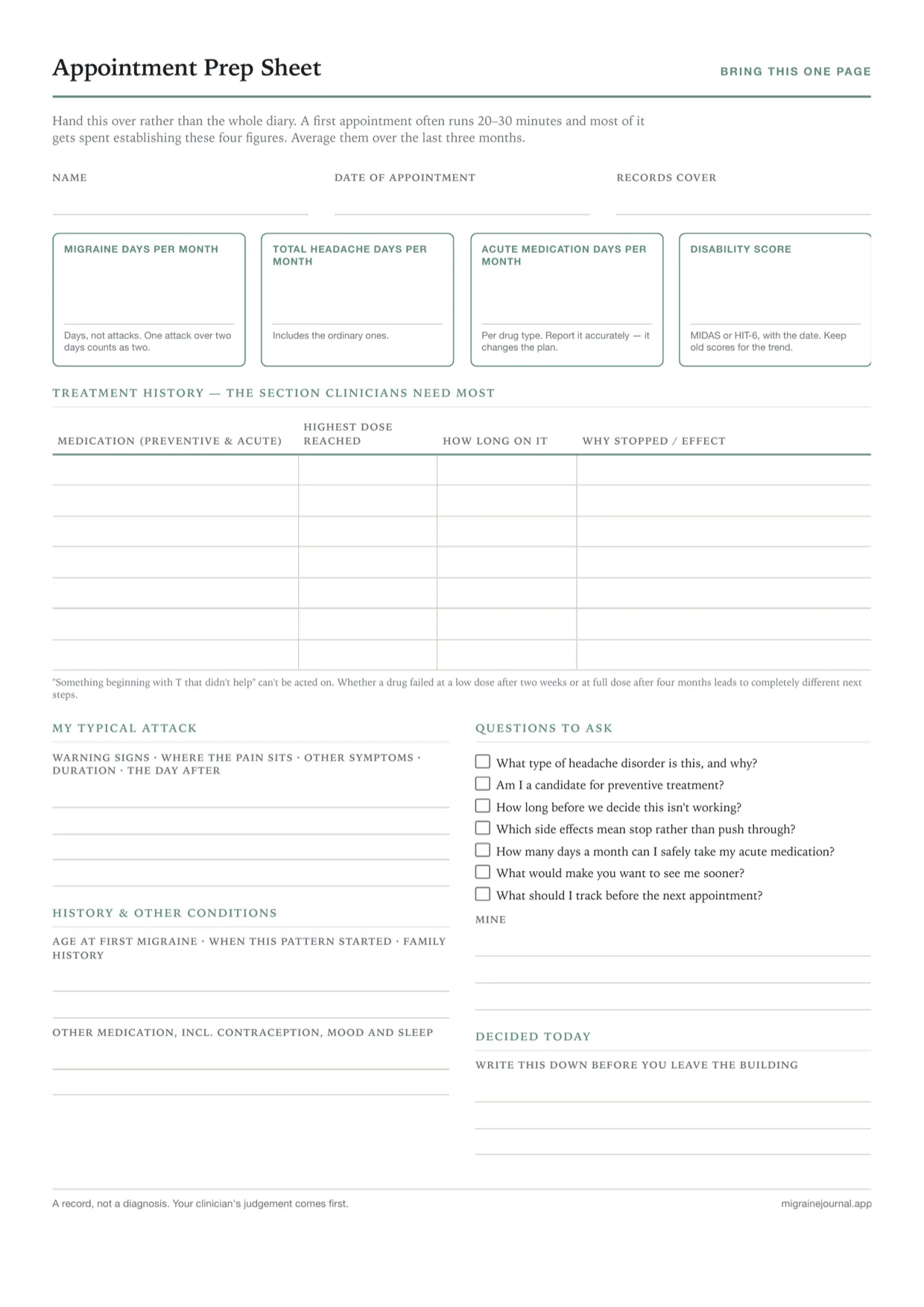
- Age at first migraine, and roughly when the current pattern started
- The four numbers above, averaged over three months
- Your typical attack: warning signs, where the pain sits, other symptoms, how long it lasts, what the day after is like — how to describe migraine pain to a doctor covers the six features they listen for
- Every preventive medication you’ve tried: name, highest dose reached, how long you stayed on it, why you stopped
- Every acute medication: name, whether it works, how often you use it
- Other conditions and medications, including the contraceptive pill and anything for mood or sleep
- Family history of migraine
- Anything that reliably precedes an attack
The treatment history is the section people prepare worst and clinicians need most. “I tried something beginning with T and it didn’t help” cannot be acted on. Whether a drug failed at a low dose after two weeks or at full dose after four months leads to completely different next steps, and if you can only reconstruct one thing before the appointment, make it this.
What not to bring
Ninety pages of daily diary entries.
This feels like diligence and functions as an obstacle. Nobody can read it inside the appointment, so it either gets ignored or eats the time you needed for questions. A three-month calendar view with attack days marked and severity shaded communicates the same information in four seconds.
Migraine Journal generates exactly this as a PDF: an attack calendar for the range, migraine days normalised per month, medication days, and your assessment scores. Print it, bring it, and keep the detail in reserve for anything they want to dig into.
Also leave out lists of things you read online, unless there’s a specific question attached. And don’t bring a diary that starts three weeks ago, then apologise for it — three weeks is genuinely too short to read a pattern from, which how to track migraine triggers explains.
Questions worth asking
Write these down too. They evaporate the moment someone in a white coat starts talking.
- What type of headache disorder do you think this is, and what makes you say that?
- Am I a candidate for preventive treatment, and what’s the threshold you use?
- How long should I stay on this before we decide it isn’t working?
- What side effects should make me stop rather than push through?
- How many days a month is it safe for me to take my acute medication?
- What would make you want to see me sooner?
- What should I be tracking between now and the next appointment?
That last one is genuinely useful and rarely asked. It turns the interval into an experiment rather than a wait.
Practical logistics
Book a time of day when you’re typically well, if you have any pattern at all. Take someone with you if attacks affect your memory or concentration, and let them take notes so you can listen. Ask permission to record the conversation on your phone; most clinicians are fine with it.
Bring your actual medication boxes if the names are a blur. A photo of each box works.
Afterwards, write down what was decided and the reasoning behind it, that same day. Six weeks later you’ll want to know why you settled on the dose you did.
If it’s a follow-up
The four numbers again, plus one comparison: what changed since last time, and the disability score alongside the old one.
Follow-ups fail when both sides are working from impressions. Two figures and a date make the twelve-minute version of the appointment productive, which is usually the version you get.
Getting the record into the room is its own small task, and doing it badly wastes the work — how to share your migraine diary with your doctor covers format, channel and timing, including why the raw export is the wrong thing to hand over. If the appointment is heading toward one of the newer preventives and you’re in the US, what a CGRP prior authorization asks for is worth reading before rather than after the denial.
None of this is a substitute for your clinician’s judgement, and if attacks are escalating or the pattern shifts in a way that worries you, that’s a reason to contact them sooner rather than saving it for the next slot. If you don’t have a tracking habit yet, our printable migraine diary template is designed to produce these four numbers by the time you sit down — and the rest of the appointment guides start from the same record.
Quick answers
What should you bring to a neurologist appointment for migraine?
Four numbers on one page — migraine days per month, total headache days per month, acute medication days per month, and a disability score — plus a full medication history with doses and why each one stopped. Everything else is supporting material.
Should you bring your whole migraine diary?
No. Ninety pages of daily entries cannot be read inside the appointment, so they either get ignored or eat the time you needed for questions. A three-month calendar with attack days marked and severity shaded says the same thing in four seconds.
What is the difference between migraine days and migraine attacks?
Days, not episodes. An attack running from Tuesday evening into Wednesday afternoon is two migraine days. The thresholds that define chronic migraine are counted in days, so the distinction changes which category you fall into.
What is the most useful question to ask a neurologist?
What should I be tracking between now and the next appointment? It is rarely asked, and it turns the gap between visits into an experiment rather than a wait.
Walk in with the numbers, not an impression
Attack count, average severity, acute-medication days, and a printable summary of the last 30 days — the four things the questions in this post are really asking for. MIDAS and HIT-6 are built in, so the disability score is already calculated when you arrive.
This article is general information, not medical advice. Talk to your GP or neurologist about your own symptoms, medication, and treatment.