 Migraine Journal
How to Track Migraine Triggers Without Fooling Yourself
Most trigger tracking produces confident wrong answers. How to track migraine triggers properly: what to record, what to ignore, and the trap everyone hits.

Record six things within a day of each attack: when it started, how bad it got, how long it lasted, what you took and at what time, how you slept the night before, and anything unusual in the preceding day. Keep it up for three months before drawing any conclusion. Change one thing at a time when you start testing.
That’s the whole method. The rest of this is about why it goes wrong, because trigger tracking has a specific failure mode: it very reliably produces confident answers that are incorrect.
The six fields, and why the others can wait
Start time. Not “Tuesday” — the hour. Time of day is one of the few patterns that shows up quickly, and it’s the field people are laziest about.
Severity, on a consistent scale. Any scale works as long as you don’t redefine it halfway through. The common drift is that a 7 in month one becomes a 5 by month three, once you’ve had worse. Anchor it: write down now what your 5 and your 9 mean, and check back against that.
Duration. Ends when the pain stops, recorded separately from the foggy day afterwards.
Medication and the exact time taken. This is the field a doctor can actually use, and the one nobody remembers accurately by the following morning.
Sleep the night before. Hours, roughly. Short nights are among the most commonly reported triggers and among the easiest to record honestly.
One line of context. Skipped lunch. Deadline. Wine. Period started. If that last one keeps appearing, there is a specific counting method for telling whether your migraines are hormonal. Long drive.
Resist adding more fields. A twenty-field diary gets abandoned in week three, and an abandoned diary is worth nothing. The Migraine Trust makes the same point: keep it simple and record basic information.
The trap: what you think is a trigger may be the attack starting
This is the mistake that invalidates more trigger diaries than everything else combined, and most articles on the subject never mention it.
A migraine attack often begins hours before the pain, in a phase called the premonitory or prodrome phase. It can involve food cravings, yawning, neck stiffness, mood changes, thirst, and heightened sensitivity to light and smell.
Now look at that list again. Craving chocolate. Feeling thirsty. Stiff neck. Finding the office lights unbearable.
These are the classic “triggers” people report, and in many cases the causality runs the other way: the attack was already underway, and it made you want the chocolate. The Migraine Trust has written directly about this confusion, and it explains a lot of the frustration in trigger hunting. People eliminate chocolate, still get attacks, conclude tracking is useless, and stop.
The practical defence is to record the time of the suspected trigger relative to the attack, not just its presence. Chocolate eaten at 4pm before a 6pm attack is suspicious in a way that chocolate eaten three days running with no attack is not. Over months, real triggers hold up across many attacks; premonitory symptoms cluster tightly in the hours before onset, every time.
The warning signs are real data — just not about triggers
None of this means the pre-attack signals are imaginary. The opposite: they’re reliable enough to be useful, once you stop reading them as causes.
In a three-month electronic diary study, people who reported warning symptoms correctly predicted a full migraine from 72% of the diary entries where those symptoms appeared. The most common ones were feeling tired and weary (72% of attacks with warning features), difficulty concentrating (51%), and a stiff neck (50%).
Read that list against the trap above. Tiredness, poor concentration, neck stiffness — the exact things that get written down as “triggers” — turn out to be usable predictions. Logged as “possible prodrome, 2pm” rather than “trigger: bad sleep”, the same observation stops corrupting your trigger record and starts buying you something concrete: a two-to-twelve-hour warning, which is enough to take medication early, move the difficult meeting, or get home before the aura does. Which ones are yours is the part no textbook can supply: the warning signs that actually precede your own attacks come out of your record, not the standard list.
Log within the day, or don’t bother
Memory of pain is compressed and unreliable. By the next morning you will have lost the start time, softened the severity, and quietly reordered the events of the previous day into a story that makes sense.
Worse, you’ll reconstruct it around whatever you already suspect. If you believe red wine is your trigger, you will remember the wine and forget the four hours of sleep. Sleep is worth testing on its own terms rather than as the thing you notice second — the two-average method for sleep and migraines is a self-contained fortnight and it rules the factor out as often as it confirms it.
The realistic bar is logging before you go to sleep, or first thing the following morning if the attack ran into the night. Anything beyond that is a guess written in a diary, which is more dangerous than no diary because it looks like data.
Keep the entry short enough that you’ll do it during a bad week. Under a minute is the right target. Migraine Journal was built around that constraint, and it captures the 24-hour barometric-pressure change automatically at the moment you log, since that’s the one variable memory cannot supply, and a lookup made days later is only as precise as the time and place you give it.
Weather is the clearest example of why you need months, not weeks
Around 80% of people with migraine report weather as a trigger. The research is far less certain. A 2025 systematic review of barometric pressure and migraine found several studies linking pressure changes to attack frequency, few showing any association with severity, and none with duration.
Read that carefully, because it’s a useful shape. Even where an effect exists, it may only touch how often attacks come, not how bad they are. If you spend six weeks watching for a pressure drop to predict a severe attack, you’re testing something the evidence doesn’t support, and you’ll conclude wrongly.
Frequency effects only become visible across enough attacks to compare rates. That’s the real argument for three months. If weather is your main suspect, why the pressure studies disagree — and the exact two fields to record — has its own page.
Change one thing at a time
Once you have a suspect, the instinct is to overhaul everything at once: cut caffeine, fix your sleep, drop cheese, start exercising.
If attacks improve, you’ve learned nothing about which change mattered, and you’ve committed to four restrictions indefinitely. If they don’t improve, you’ve learned nothing at all and given up several things you enjoyed.
Take one variable. Hold it for four to six weeks. Keep logging. Then decide.
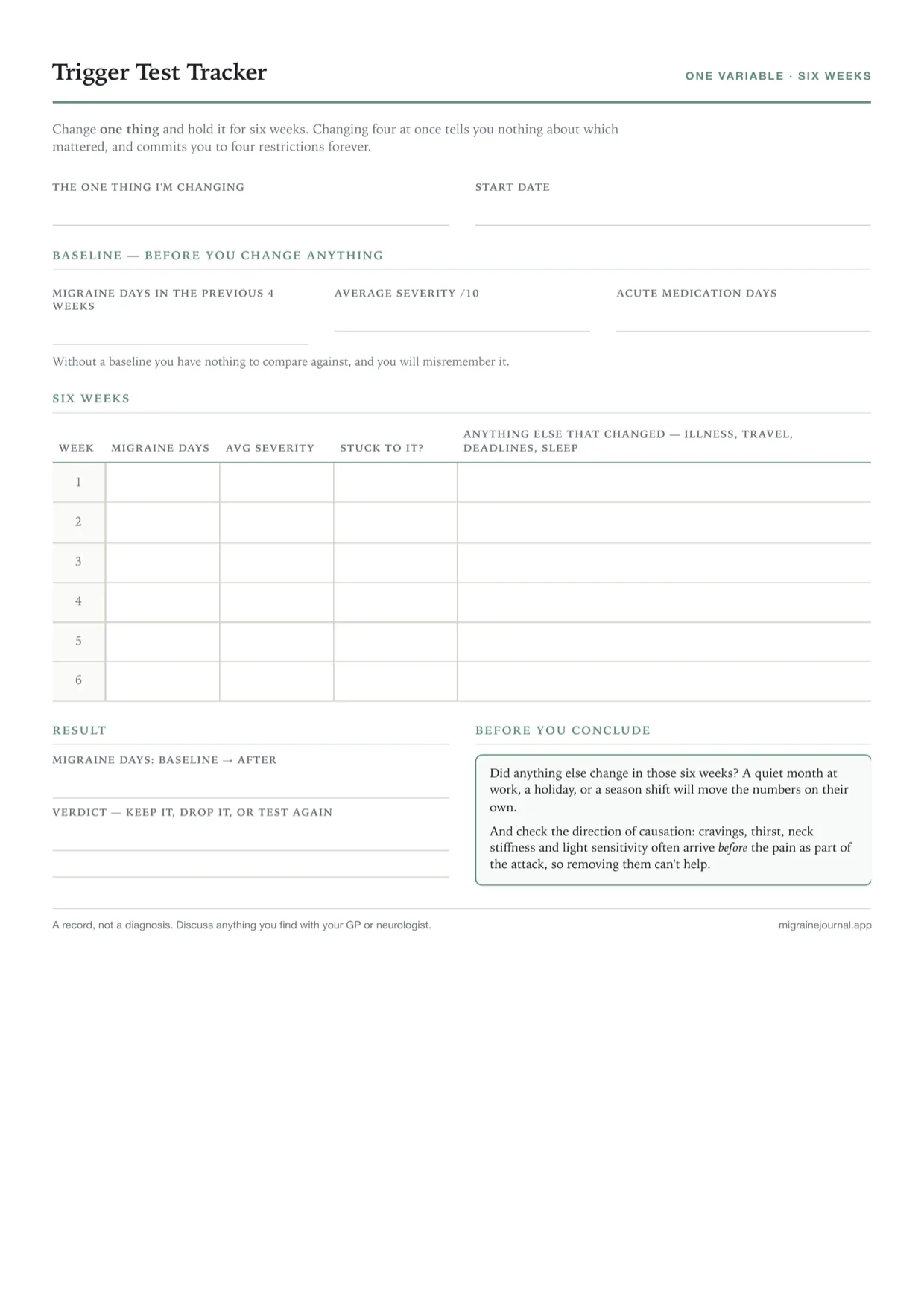
There’s a printable for exactly this: the trigger test tracker (PDF, one page, free). It has a baseline box, six weekly rows, and a prompt to record anything else that changed during the test — which is the thing that most often produces a false result.
What a clean test looks like, start to finish
Say the suspect is red wine, because it usually is.
Baseline first. You already have it if you’ve been logging: attacks in the last six weeks, average severity, and how often wine actually appeared. Suppose it’s five attacks in six weeks, wine on nine evenings, wine within a day of an attack twice.
The test: no red wine for six weeks. Nothing else changes — same caffeine, same sleep intentions, and you keep logging every attack and the quiet days. Each week you fill one row: migraine days, average severity, stuck to it or not, and anything else that changed. That last column is the one that saves you — if week four contains a house move and two 2am nights, the attack in week four is not evidence about wine.
The verdict, six weeks later: five attacks against a baseline of five is an answer. Two attacks is a lead worth extending another six weeks, not a conviction — one good stretch happens on its own often enough. And if you cheated in week three and nothing happened, that row is data too, arguably the best row in the sheet.
What a clean test costs is patience with one variable while your instinct screams to fix everything. What it buys is the thing almost nobody with a trigger theory has: a before-and-after with the same person, the same scale, and only one difference.
Reading the diary
After three months, don’t scan for the trigger that appears most often. Frequency alone is misleading, because your most common recorded factor is usually just your most common day.
Two better questions:
How often does the factor appear before an attack, compared with how often it appears at all? Coffee every morning and attacks twice a month means coffee is not your trigger, however often it shows up next to one.
Do factors stack? Many people don’t have a single trigger; they have a threshold. Short sleep alone is survivable, a deadline alone is survivable, and both in the same week is not. This is why single-cause hunting so often fails, and why recording sleep and stress on non-attack days is worth the extra ten seconds.
Paper works
None of this requires an app. A notebook by the bed with six headings ruled into columns does the job, and a paper diary you actually fill in beats a sophisticated one you don’t. If you’d rather print something ready-made, our printable migraine diary template has the six fields already laid out.
If you’d rather not use paper, the choice is worth making once and then leaving alone — the four questions that decide whether a tracking app survives to month three matter more than any feature list, and Apple Health will log a headache in four taps if all you need is the bare minimum already on the phone.
What tracking cannot do is interpret itself, and none of this replaces a clinician. Its real payoff comes at the appointment, where three months of records changes the conversation completely — what to bring to a neurologist appointment covers what to do with the diary once you have one, and the rest of the tracking guides build on the same three-month record.
Quick answers
How long should you track migraine triggers before drawing a conclusion?
Three months. Where weather and similar factors show an effect at all, it tends to be on how often attacks come rather than how bad they are, and frequency only becomes visible across enough attacks to compare rates against each other.
Can a migraine trigger actually be the attack starting?
Often, yes. Chocolate cravings, thirst, neck stiffness and finding lights unbearable are common premonitory symptoms, so the attack was already underway when you noticed them. Record the time of the suspected trigger relative to onset, not just that it happened.
How many things should you change at once when testing a trigger?
One, held for four to six weeks while you keep logging. Changing several at once means an improvement tells you nothing about which change mattered, and no improvement tells you nothing at all.
Is it enough to write up an attack the next day?
Not really. By the next morning the start time is gone, the severity has softened, and the day gets reordered around whatever you already suspect. Log before you sleep, or first thing if the attack ran into the night.
Track it in under a minute
Logs an attack in seconds, records the barometric-pressure change automatically, and prints the summary a neurologist asks for.
This article is general information, not medical advice. Talk to your GP or neurologist about your own symptoms, medication, and treatment.