 Migraine Journal








Migraine Absence Log: Free Printable for Work Sick Days
A free printable migraine absence log: one line per day migraine costs you work, days worked through included, and a 90-day total for your manager or doctor.

Download the migraine work absence log (PDF, 1 page): free, no email required. Keep it at home, not at work. It’s your record, not your employer’s.
On iPhone and would rather not print? Migraine Journal keeps the dated record for you: each attack is time-stamped as you log it, a note holds “left at 2pm, told Sam”, and the calendar counts migraine days per month without you adding anything up. Free to track.
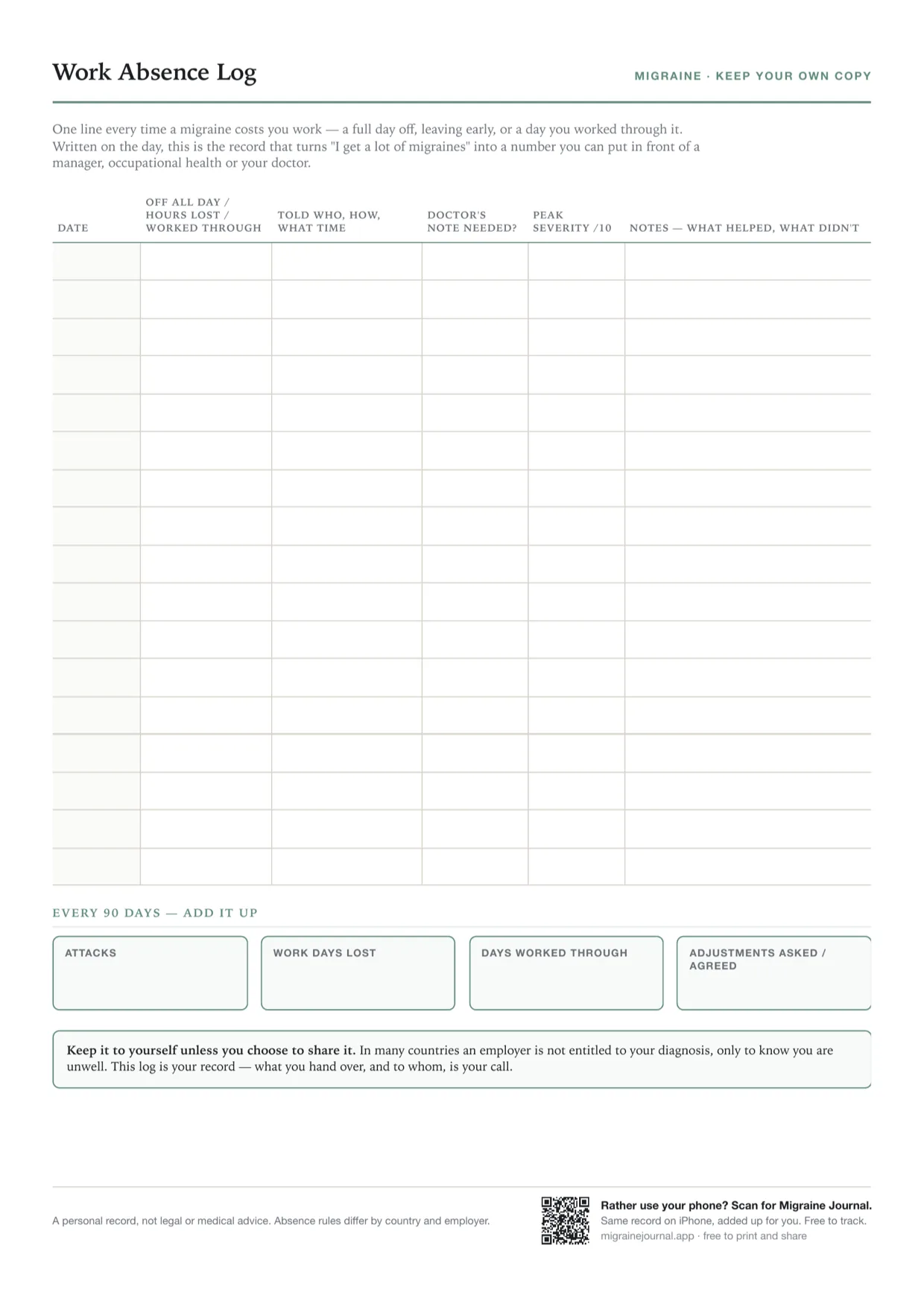
Your employer already has a record of your migraine absences. It sits in the HR system, it counts the days you called in, and it’s the only version anyone will look at unless you keep your own. This sheet is your version, and it records the thing theirs can’t: the days migraine cost you work while you stayed at your desk.
What goes on each line
One line every time a migraine touches a working day. The columns:
Date.
Off all day / hours lost / worked through. Write one of the three. “Off” is a full day. “Hours lost” is leaving at 2pm or starting at 11. “Worked through” is the day you were there, behind sunglasses, getting a third of your usual work done.
Told who, how, what time. “Sam, text, 07:10.” This column protects you more than any other. If there’s ever a dispute about whether you followed the call-in procedure, a line written on the day beats anyone’s memory. Calling in sick with a migraine has the actual messages to send.
Doctor’s note needed? Whether a note was asked for, and whether you got one. Rules on when a note is needed vary by country and employer; in the UK, for example, you can self-certify for up to seven days before a fit note is needed.
Peak severity out of 10, and notes. What helped, what didn’t, what the day cost.
Why the “worked through” days matter
Most migraine absence isn’t absence. It’s a day at half speed that nobody records, including you.
Count them anyway. They’re the evidence that what you’re asking for (a later start after a bad night, a dimmer desk, permission to work from home on attack days) would help, because they show the problem is bigger than the sick-day count suggests. They’re also what disability questionnaires ask about. The MIDAS questionnaire, built to measure headache-related disability for use in clinical practice, scores days of limited activity over the past three months, and it asks how many days your productivity at work was cut by half or more separately from days missed entirely.
Every 90 days, add it up
The four boxes at the bottom:
- Attacks
- Work days lost
- Days worked through
- Adjustments asked for or agreed
Ninety days lines up with the window clinicians and managers think in. “I get a lot of migraines” is a description. “Nine attacks since August, four work days lost, seven worked through, a later start agreed in September and it’s helped” is a conversation someone can act on. How to ask for migraine accommodations at work explains how to open that conversation, and the migraine accommodation letter template puts the totals into a request. The adjustments box is the before-and-after: if the adjustments are working, the next 90 days show it.
Who gets to see it
The box at the bottom of the sheet says it plainly: keep it to yourself unless you choose to share it.
What an employer is entitled to know varies a lot. In the Netherlands, for example, the data protection authority says the nature and cause of an illness are not information an employer may ask for. In the UK, The Migraine Trust notes that it’s your choice whether to tell your employer, but that their duty to make reasonable adjustments generally depends on them knowing. In the US, a leave certification has its own rules, and documenting migraines for FMLA covers what that form asks for.
So the log’s job is to give you the numbers. What you hand over, to whom, is a separate decision: perhaps the totals to your manager, the full sheet to occupational health or your doctor. It’s a personal record, not legal advice, and if you’re in a dispute, the rules where you work are the ones that count.
Paper or the app
Paper suits this sheet well. It stays at home, it has a column for exactly the work detail an employer’s system leaves out, and a single page is easy to photocopy for an occupational health appointment.
Where Migraine Journal helps is the record underneath it. Every attack is stamped with the date and time when you log it, the attack timer records how long it lasted, and the notes field holds the work detail (“left 14:00, told Sam by text”). The History calendar shows migraine days per month. The doctor report for the last 30 days is free to make as a PDF; longer ranges are part of Plus.
What the app doesn’t have is a dedicated “worked through” or “told who” column, so those go in the notes, or on this sheet. Many people use both: the app to catch the attack on the day, the sheet for the 90-day total.
Print settings
Print at 100% on A4; it fits US Letter. Seventeen lines is roughly a quarter’s worth for most people. Print a second sheet when you run out, and keep the old ones; the trend over a year is worth more than any single quarter. All the printables are at free downloads.
Quick answers
What should a migraine absence log record?
One line each time migraine costs you work: the date, whether you were off all day, lost some hours or worked through it, who you told and how, whether a doctor's note was needed, peak severity, and a short note on what helped.
Why log days you worked through a migraine?
Because they are the hidden half of the cost. Your employer's system records days off; it never records the day you sat at your desk at half capacity. Disability questionnaires such as MIDAS count those reduced days too.
Do I have to tell my employer it's migraine?
It depends on where you work, and it is often your choice. In the Netherlands, for example, the data protection authority says employers may not ask the nature or cause of an illness. Getting workplace adjustments usually does need your employer to know.
Why add the log up every 90 days?
Because three months is a common window for the conversations it feeds: the MIDAS disability score asks about the last three months, and a recent quarter is what a manager or occupational health adviser can act on.
Or skip the printing
The sheet works on its own, and plenty of people never want anything else. The app records the same fields, plus the barometric-pressure change over the preceding 24 hours, which is the one column nobody can fill in from memory afterwards.
This article is general information, not medical advice. Talk to your GP or neurologist about your own symptoms, medication, and treatment.