 Migraine Journal
Migraine Accommodation Letter Template: What to Include
A free migraine accommodation letter template, plus what belongs in each of the five sections, what to leave out, and how to phrase each ask.

The letter has one job: to turn an unpredictable condition into a small number of specific, cheap, checkable requests, on a dated document that exists after the conversation ends. It is not there to prove you are ill, win sympathy, or explain migraine. Five short sections do it, and the whole thing fits on one side of A4.
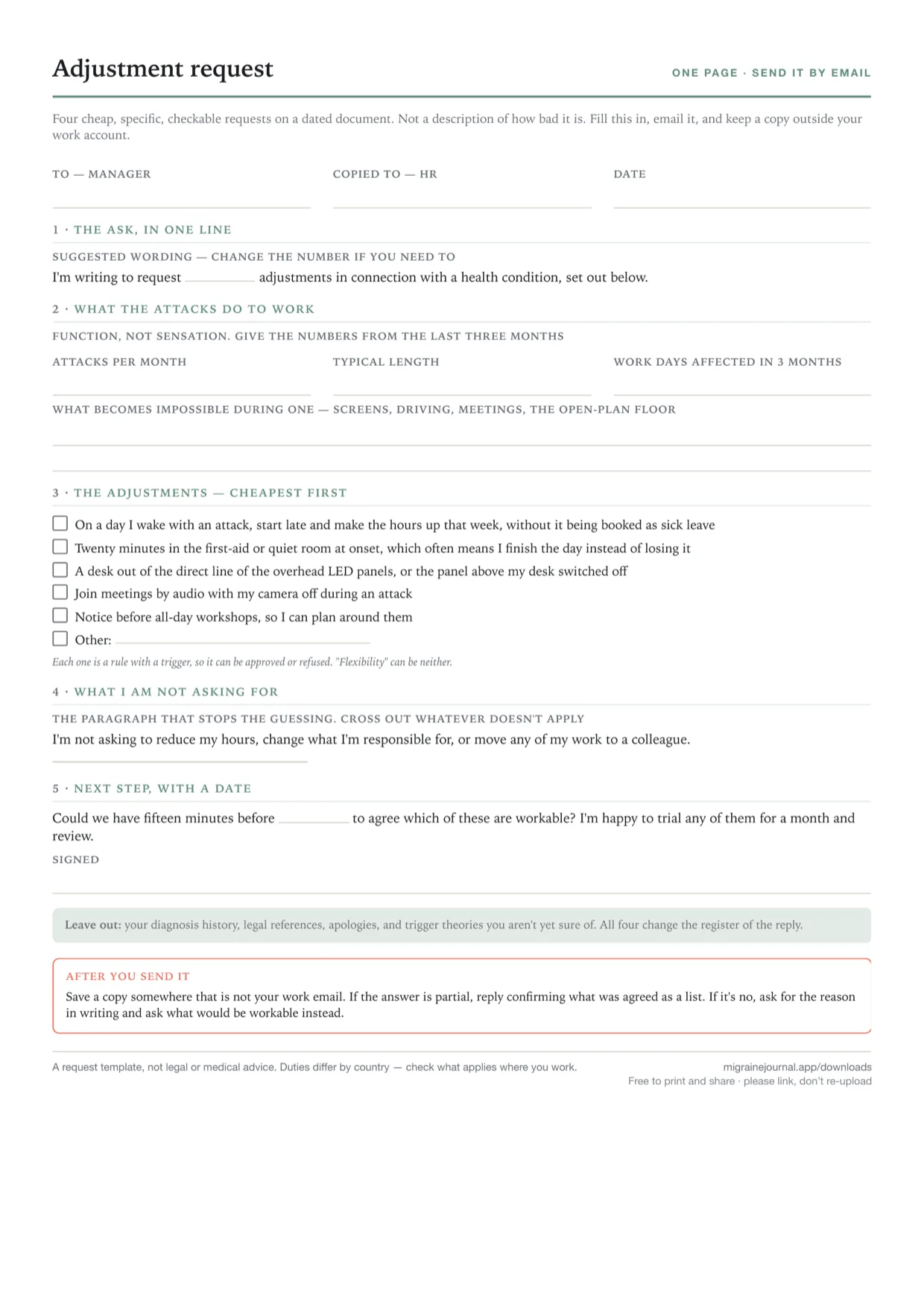
The migraine accommodation letter template is free, one page, no email required. Fill it in, keep a copy, send it to your manager and copy HR or occupational health if you have either.
Before the sections, the one decision that changes everything downstream.
Requests, not descriptions
Most people write a letter that is four paragraphs about migraine and one line about what they want. Reverse that. Your employer does not need to understand the neurology, and cannot act on it if they do. They need to know which four things you are asking for and roughly what each costs them.
The legal detail below is UK-specific, and it is the only jurisdiction described on this page. In the UK, Acas explains that an employer must make reasonable adjustments once they know, or could reasonably be expected to know, that someone is disabled, and that the employer pays for them. Acas also publishes a general reasonable adjustment request template, which is worth having open beside this one if your employer has a formal process.
Elsewhere the framework, the terminology and the trigger for it are different — what counts as a covered condition, who has to be told, and what an employer must do about it all vary. Look up what applies where you work rather than assuming any of the above transfers. The letter itself does transfer, because it is not a legal document: a request specific enough to say yes to gets answered, and a description of suffering does not.
The five parts
1. One line on what you are asking for. “I’m writing to request four adjustments in connection with a health condition, set out below.” No preamble. Someone skimming on a phone should know what this document is within four seconds.
2. Three or four sentences on what the attacks do to work. Not what they feel like. What they do. Frequency as a number, duration, and the functional consequence: screen work becomes impossible, you cannot drive, you lose the rest of the day. If you have a record, give the count for the last three months rather than a vague sense of it. Six weeks of a printable diary is enough to write this sentence honestly, and Migraine Journal will give you the attack count and average duration for a date range if you would rather not add them up by hand.
3. The adjustments, as a numbered list. One line each, phrased as the change rather than the reason. Ordered with the cheapest first, because the first yes makes the second easier.
4. What you are not asking for. This is the part almost everyone omits and it does more work than any other line. “I’m not asking to reduce my hours or to change what I’m responsible for.” A manager reading an adjustment request is quietly estimating how much of your job is about to become someone else’s problem. Answer that before they finish worrying about it.
5. A next step with a date. “Could we have fifteen minutes in the next fortnight to agree which of these are workable?” A letter without an ask sits in a folder.
The unpredictability problem
Here is where migraine breaks the standard adjustment form, and where a generic template will let you down.
Most workplace adjustments assume a stable limitation. A chair, a screen reader, a fixed later start. Yours is intermittent, invisible between attacks, and arrives with no notice. If you write it as a stable limitation you will be offered something that does not help. If you write it as “I sometimes feel awful and need flexibility”, you have asked for nothing.
Write it as a rule with a trigger. That is the pattern that survives being read by a stranger in HR:
- Not “flexibility around start times”, but “on a day I wake with an attack, the ability to start late and make the hours up that week without booking it as sick leave.”
- Not “I need to avoid bright light”, but “a desk out of the direct line of the overhead LED panels, or permission to work with the panel above my desk switched off.”
- Not “I need somewhere to lie down”, but “twenty minutes in the first-aid room at onset, which often means I finish the day instead of losing it.”
- Not “fewer meetings”, but “the option to join a meeting by audio with my camera off during an attack.”
Each of those is a sentence someone can approve or refuse. “Flexibility” is not.
The same discipline pays off on a US FMLA certification, which asks for episodic frequency and duration in almost those terms — what that form actually asks for is worth reading before a doctor fills it in on your behalf.
The third one is worth pushing hardest for and is the one most often granted, because the arithmetic favours the employer. Twenty minutes in a dark room that saves five hours of the afternoon is a good trade, and saying that out loud in the letter is fair game.
What to leave out
Your diagnosis history. You are not obliged to provide a medical essay, and a long one invites the reply that they will need to refer you to occupational health before considering anything, which adds six weeks.
Anything that sounds like a warning. Legal references at this stage change the register of the conversation from a request to a threat, and the person reading it stops thinking about your desk and starts thinking about their own exposure. Keep the law in your back pocket. The escalation route matters only after a written refusal, which is a separate conversation with its own tactics.
Apologies. “I’m so sorry to be a nuisance” is in almost every first draft. It frames the request as an imposition, and you are asking for something ordinary.
Trigger theories. Save the perfume-in-the-open-plan-office argument for later, and be reasonably sure of it first. A trigger claim that turns out to be wrong costs you credibility on the requests that were solid.
Send it, so that it exists
Email, not a conversation. This matters more than it sounds.
A verbal chat by the kettle is easy to have and impossible to point at in nine months. A dated email establishes when your employer knew, which in the UK is the moment their duty to consider adjustments begins. Attach the filled-in page or paste it into the body, whichever your workplace is more likely to read.
Then keep a copy somewhere that is not your work email account, because access to that can end abruptly, and this is exactly the document you would want on the day it does.
If the reply is a partial yes, write back confirming what was agreed, in a list, and thank them. That message is now the record. If the reply is no, ask for the reason in writing and ask what would be workable instead, which is a much harder question to refuse than a repeat of the original request.
One thing worth knowing about how this lands on the other side: managers who say no to adjustment requests are usually not hostile, they are guessing, and what they are guessing at is what supporting someone with migraine actually requires of them. A letter that answers that question in five short sections is doing most of the persuading before anyone has to be persuaded. The rest of the migraine-at-work guides cover both sides of that table.
Quick answers
What goes in a migraine accommodation letter?
Five short sections on one page: one line on what you're requesting, three or four sentences on what attacks do to your work, the adjustments as a numbered list cheapest first, what you are not asking for, and a next step with a date.
Why does an adjustment request for migraine need different wording?
Most adjustment forms assume a stable limitation. Migraine is intermittent and arrives with no notice, so write each ask as a rule with a trigger — “on a day I wake with an attack, the ability to start late and make the hours up that week” — rather than as “flexibility”.
Which section do people leave out?
What you are not asking for. A manager reading the request is quietly estimating how much of your job is about to become someone else's problem, and one sentence — “I'm not asking to reduce my hours or change what I'm responsible for” — answers that before they finish worrying.
Should you send it by email or just talk to your manager?
Email. A chat by the kettle is impossible to point at nine months later, and a dated email establishes when your employer knew, which in the UK is when the duty to consider adjustments begins. Keep a copy outside your work account.
Or skip the printing
The sheet works on its own, and plenty of people never want anything else. The app records the same fields, plus the barometric-pressure change over the preceding 24 hours, which is the one column nobody can fill in from memory afterwards.
This article is general information, not medical advice. Talk to your GP or neurologist about your own symptoms, medication, and treatment.