 Migraine Journal
Printable Migraine Trigger Test Tracker (Free, 6 Weeks)
One variable, six weeks, one page. Built around the two columns that stop a trigger test producing a confident wrong answer — and a verdict box at the end.
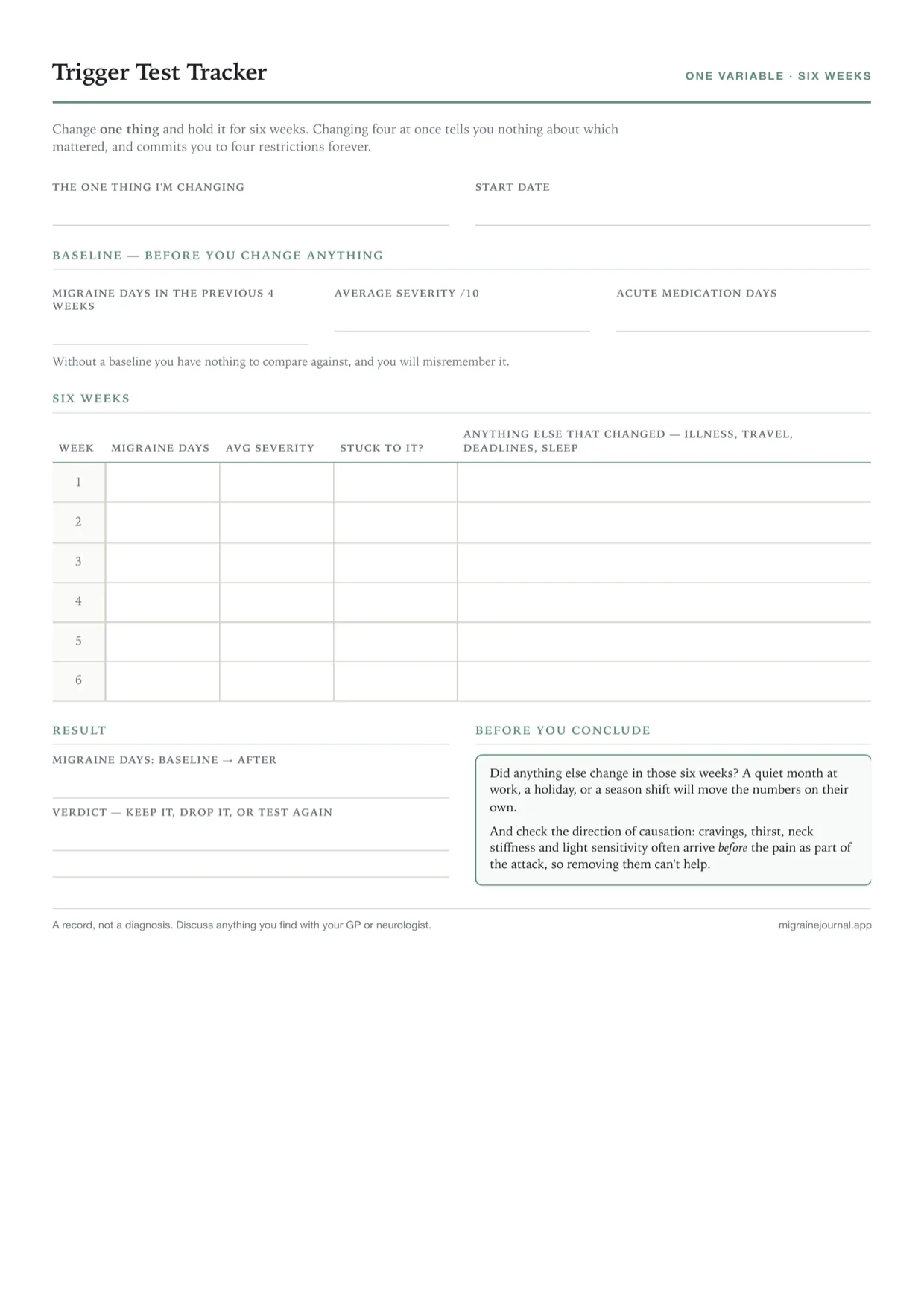
Download the trigger test tracker (PDF, 1 page) — free, no email required. One sheet per trigger you want to test. Print a fresh one each time.
Most trigger testing fails in a specific and repeatable way: several things change at once, there is no baseline to compare against, and the verdict gets formed from how the six weeks felt rather than from what was written down. This sheet is built to make each of those harder.
The box at the top: one variable, named
Write the single thing you are changing, and the date you start.
Naming it in writing does more work than it looks like it should. “Cutting back on wine” is not a test — it has no threshold and you will grade yourself generously in week five. “No red wine at all” is a test. So is “in bed by 11:30 every night” or “coffee before 10am only”.
One sheet holds one variable. If you want to test two things, that is two six-week runs and about three months, which sounds slow until you consider that the fast version produces an answer you cannot use.
The baseline row
Above the six weekly rows there is a baseline: your attack rate over the six weeks before the test, plus average severity, and how often the suspected trigger actually occurred.
That last figure is the one people skip and it decides whether the test is worth running. If you have wine on nine evenings in six weeks and an attack followed within a day on two of them, that is a testable suspicion. If you have wine twice in six weeks, removing it proves nothing either way, and you have just found out before spending six weeks on it.
If you have been keeping a diary you already have the baseline and it is a lookup. If you haven’t, run six weeks of ordinary logging first — the printable migraine diary is laid out for it, and starting a trigger test with no baseline is the most common reason one produces nothing.
The six weekly rows
Each week: migraine days, average severity, whether you stuck to it, and what else changed.
Stuck to it, yes or no. Honestly. A week you broke the test is not a spoiled week — it is a small natural experiment sitting inside the big one. If you slipped on Thursday and nothing happened, that row is arguably the most informative on the sheet.
What else changed. This is the column that separates a readable result from an uninterpretable one, and it is the field no other trigger worksheet has. A week containing a house move, two nights of four hours’ sleep and a deadline is not evidence about cheese. Without the column you will not remember in week six that week four was chaos, and the attack in week four will quietly count against the trigger.
The verdict box
At the bottom, three lines: the baseline rate, the test rate, and what you conclude.
Write the numbers before you write the conclusion. The order matters, because a conclusion written first tends to reshape how the numbers get read.
Some honest guidance on reading it. Five attacks against a baseline of five is an answer, and it is the most common answer. Two against five is a lead worth extending another six weeks rather than a conviction — one good stretch happens on its own often enough that a single six-week improvement is weak evidence. And a difference of one attack is noise.
The trap this sheet cannot save you from
If the thing you are testing is a food you crave, the test may be answering a question you did not ask.
Craving specific foods is a common premonitory symptom, part of the attack rather than its cause, which means the chocolate you ate at four often arrived because an attack was already underway at three. Removing it changes nothing and the diary looks like it exonerated the food, which in a sense it did. Why the famous trigger-food list is wrong covers that specific confusion, and how to track migraine triggers without fooling yourself covers the general version.
Test timing before you test contents. Gaps between meals is one line a day, needs no restriction at all, and separates the two explanations cleanly.
Print settings
Print at 100% scale rather than “fit to page”. A4, prints fine on US Letter. Black and white is fine.
Keep it somewhere you will see it weekly — the fridge beats a drawer, and a sheet filled in on Sunday evenings survives longer than one that needs remembering.
Migraine Journal keeps the attack counts and averages for any date range, which makes the baseline and the six-week comparison a lookup rather than an addition. The sheet works entirely on its own, and nothing about a trigger test needs an app.
A trigger test tells you about one variable in one person over six weeks. It is not a diagnosis, and anything involving cutting out a food group, changing medication, or a restriction you intend to keep is a conversation with your GP or a dietitian rather than a decision to make from a page. All six printables are at free downloads.
Quick answers
How do you test a migraine trigger properly?
Take a baseline from your existing record, remove or change one thing for six weeks, change nothing else, and keep logging attacks and the clear days. Then compare the rate against the baseline rather than against how the six weeks felt.
Why only one variable at a time?
Because if you cut four things and attacks improve, you have learned nothing about which one mattered and committed to four restrictions indefinitely. If they don't improve, you have learned nothing at all and given up things you liked.
How long should a trigger test run?
Six weeks, and it needs a baseline of similar length in front of it. Shorter runs are where people draw confident wrong conclusions, because attack frequency moves around by itself and a good fortnight happens for no reason.
What if you break the test halfway through?
Write it in the sheet. A week where you didn't stick to it is data, and arguably the most useful row on the page — if you slipped and nothing happened, that is evidence about the trigger rather than a failure of the test.
Or skip the printing
The sheet works on its own, and plenty of people never want anything else. The app records the same fields, plus the barometric-pressure change over the preceding 24 hours, which is the one column nobody can fill in from memory afterwards.
This article is general information, not medical advice. Talk to your GP or neurologist about your own symptoms, medication, and treatment.