 Migraine Journal
Free Printable Migraine Appointment Prep Sheet (PDF)
One page, filled in the night before. The four figures a clinician asks for first, your treatment history, and a box for what was decided before you leave.

Download the migraine appointment prep sheet (PDF, 1 page) — free, no email required. Print it, fill it in the night before, and hand it over rather than reading it aloud.
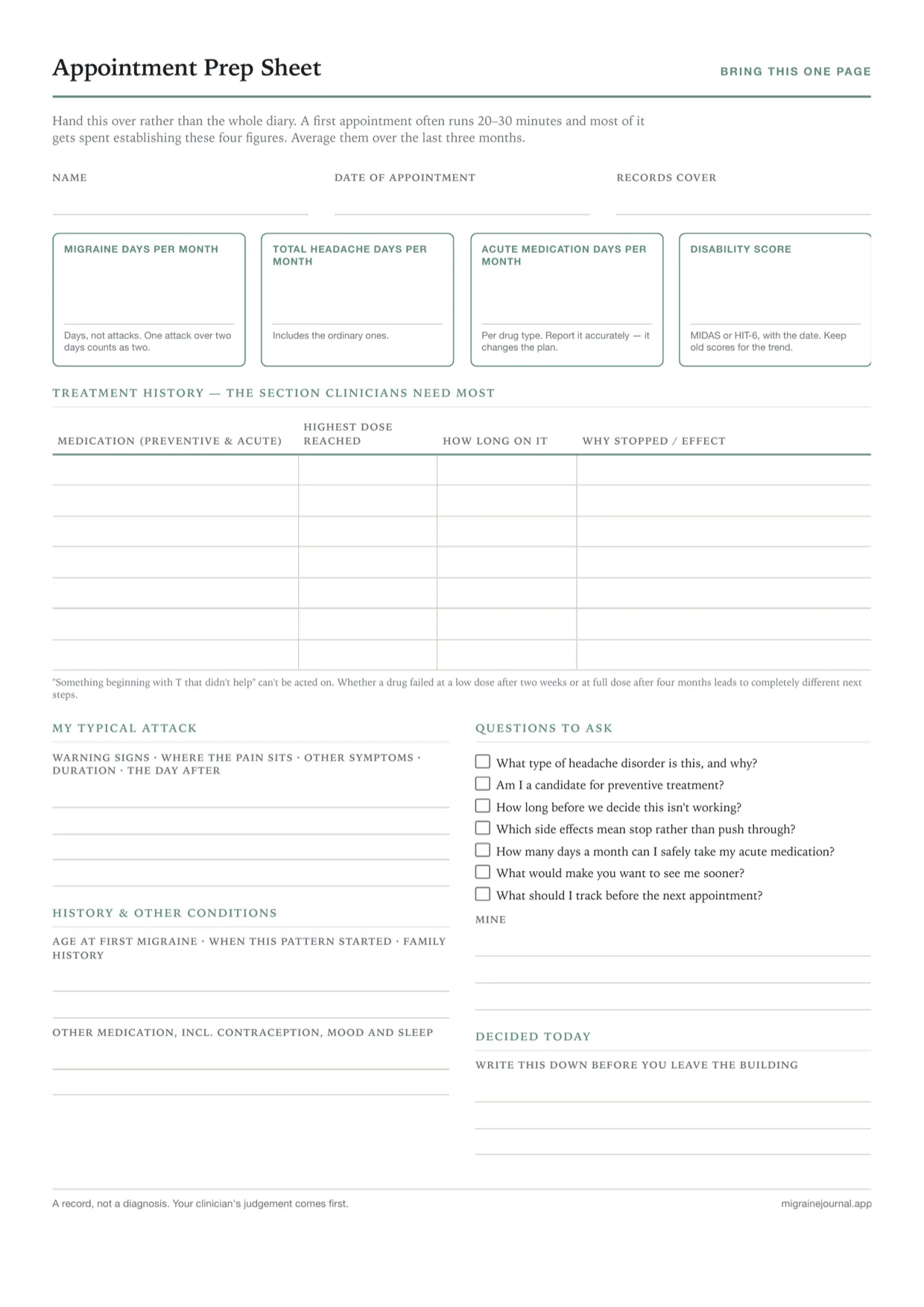
The sheet is laid out in the order the appointment runs, which is not the order most people prepare in.
The four boxes, and why they are at the top
A follow-up appointment often runs about ten minutes, and a good part of it goes on establishing these four numbers. Arrive with them filled in and you convert an information-gathering session into a treatment conversation.
Migraine days per month. Days, not attacks. An attack running from Tuesday evening into Wednesday afternoon is two migraine days, and that distinction decides which side of a threshold you land on — how many migraines a month counts as chronic works a full month through both ways.
Total headache days per month. Every day with head pain, including the ordinary ones. Counting only the bad days understates the picture by about a third for most people.
Acute medication days per month. Days you took something to stop an attack. This gets asked at every appointment, and under-reporting it is the most counterproductive thing you can do in the room — the thresholds differ by drug class, which medication overuse headache: how many days is too many sets out.
A disability score. MIDAS or HIT-6, either of which takes two minutes. A score is comparable between visits in a way that “it’s been really bad lately” is not.
Average them over three months if you have three months. If you have six weeks, write six weeks and say so — an honest short record beats a confident guess.
The treatment history is the section that decides things
Under the four boxes there is a table: drug, highest dose reached, how long you stayed on it, why you stopped.
This is the part people prepare worst and clinicians need most. “I tried something beginning with T and it didn’t help” cannot be acted on. A drug abandoned at a low dose after two weeks and a drug that failed at full dose after four months lead to completely different next steps, and only one of them counts as having tried it.
Fill this in even if it takes an evening and a rummage through old prescriptions. If you can only prepare one section, make it this one.
The questions, and the box at the end
There is a tick-list of questions, and space to add your own. Mark the three that matter most before you go in, because you will get through about four.
Then the box almost nobody else’s template has: what was decided today, and why. Fill it in before you leave the building — not that evening. The decision survives; the reasoning behind it evaporates within a day, and six weeks later the reasoning is the thing you need.
What not to bring
The diary itself.
Ninety pages of daily entries cannot be read inside a ten-minute appointment, so they either get set aside or eat the time you needed for questions. A page of totals plus a three-month calendar with attack days marked says the same thing in four seconds. What to bring to a neurologist appointment goes through the full folder, including what to leave at home.
Keep the detail in reserve. If they want to dig into a particular fortnight, you have it.
Print settings
Print at 100% scale rather than “fit to page”, or the ruled rows shrink below writing size. Laid out for A4, prints fine on US Letter with default margins. Black and white is fine — the coral rules are structure, not information.
If you don’t have a tracking habit yet, the printable migraine diary is the three-page version that produces these four figures by the time you sit down, and Migraine Journal keeps the same counts on a rolling window with MIDAS and HIT-6 built in. Either way the sheet is the thing you hand over, and the record is what fills it in.
A prep sheet is not medical advice and does not replace the appointment. It exists so the ten minutes go on the decision rather than on arithmetic. All six printables are collected at free downloads.
Quick answers
What should you take to a migraine appointment?
One page with four figures on it — migraine days per month, total headache days, acute medication days, and a disability score — plus your treatment history and the questions you don't want to forget. Not the diary itself.
When should you fill it in?
The night before, not in the waiting room. Fifteen minutes into an appointment, under time pressure, with someone waiting for you to finish a sentence, is the worst possible moment to try to summarise two years.
Why is there a box for what was decided?
Because six weeks later you will want to know why you settled on the dose you did, and by Thursday the reasoning is gone even when the decision isn't. Write it before you leave the building rather than that evening.
Do you need the app to use it?
No. The sheet is free, needs no email, and is designed to be filled in from a paper diary or from memory where that's all you have. Anything that produces the four figures for you just makes it faster.
Or skip the printing
The sheet works on its own, and plenty of people never want anything else. The app records the same fields, plus the barometric-pressure change over the preceding 24 hours, which is the one column nobody can fill in from memory afterwards.
This article is general information, not medical advice. Talk to your GP or neurologist about your own symptoms, medication, and treatment.