 Migraine Journal
Migraine Action Plan Template (Free Printable Card)
A one-page card your household fills in on a good day, so nobody has to guess what you need mid-attack. Free printable migraine action plan template.
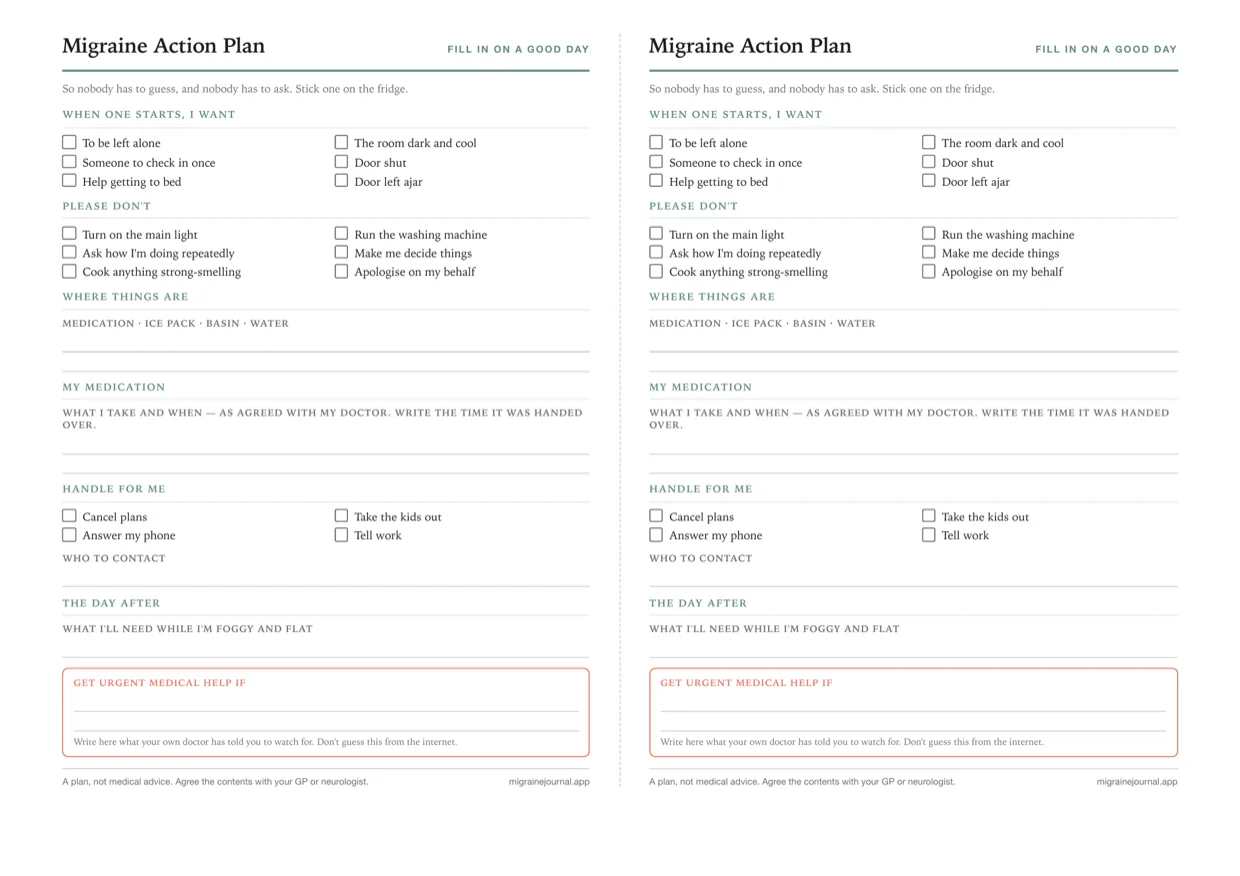
Download the migraine action plan card (PDF, two per sheet) — free, no email required. Print one sheet, cut down the dashed line, put one on the fridge and one in a bag.
The card exists to solve one specific problem: the worst moment to explain what you need is while you need it.
The negotiation is the expensive part
Someone gets a migraine. The person they live with wants to help and doesn’t know how, so they ask. Should I bring water. Do you want the door shut. Should I call your mum. Are you okay.
Every one of those questions is kind, and every one costs the person answering something they don’t have. Speech takes effort. The door opening lets light in. Being asked “are you okay” for the fourth time requires managing someone else’s worry from inside an attack.
Written down in advance, that whole exchange disappears. The card is the answer to every question before it gets asked.
What’s on it
When one starts, I want. Tick boxes: left alone, checked on once, help getting to bed, door shut or ajar, room dark and cool. Contradictory preferences are fine — they’re yours.
Please don’t. The one that changes households: no main light, no repeated check-ins, no strong-smelling cooking, no washing machine, no decisions to make, no apologising on your behalf.
Where things are. Medication, ice pack, basin, water. Fixed locations, written down, so nobody is opening cupboards at the wrong moment.
My medication. What you take and when, as agreed with your doctor, with space to note the time it was handed over. That last detail matters more than it looks: by the next morning nobody remembers whether it was 2pm or half past three, and it’s one of the few things a clinician can genuinely work with.
Handle for me. Cancel plans, answer the phone, take the kids out, tell work — plus who to contact. This is the part only someone else can do, and it’s worth more than anything they do inside the room.
The day after. Space for what you need during the recovery day, which most people don’t know exists until they see it written down.
Get urgent medical help if. Deliberately blank. Write what your own doctor has told you to watch for. Don’t fill this in from the internet, and don’t let anyone else fill it in for you.
Fill it in on a good day
That’s the whole method. Do it on a Tuesday afternoon when you’re well, together with whoever lives with you, in about ten minutes.
Two things make it work better:
Be specific rather than polite. “Please don’t ask how I’m doing repeatedly” feels rude to write and is enormously useful to read. The card is doing the work of saying the awkward thing so you don’t have to say it mid-attack.
Write what has actually worked for you, not what a list recommends. The Migraine Trust’s guidance on coping with an attack covers the measures people commonly reach for — a dark quiet room, a cold compress, sleep, letting people around you know — and is a reasonable place to start if the boxes are hard to fill. It is a menu rather than a prescription, and the value of your card is that it names the two or three items off that menu that are true for you.
Let the other person add questions. They’ll have some you’d never have thought of, usually about the outside world — whether to tell your parents, whether to cancel something you’d been looking forward to. Answer them once, in writing.
Who it’s really for
Nominally you. Practically, it’s for the person standing in the hallway feeling useless.
Most people who live with a migraine sufferer want to help and have no reliable information about how. The card converts that into a list of concrete actions, which is much easier to do well than improvising. How to help someone having a migraine covers the rest of what they can do, and what not to say covers the phrases that go wrong even when the intent is good.
Print settings
Print at 100% scale rather than “fit to page”. It’s laid out A4 landscape, two identical cards per sheet, and prints fine on US Letter. Black and white is fine.
Redo it every six months or so. Preferences change, medication changes, and a card describing what you needed two years ago quietly stops being true.
Where it fits with tracking
The action plan handles the attack. It doesn’t tell you anything about why attacks happen, which is a separate job with a separate sheet — the printable migraine diary template covers that, and Migraine Journal does the same thing in under a minute a day if you’d rather not use paper. All six printables, including this card, live at free downloads.
A plan is not medical advice, and its contents are worth agreeing with your GP or neurologist rather than settling alone.
Quick answers
What is a migraine action plan card for?
Removing the mid-attack negotiation. Every kind question — should I bring water, do you want the door shut, are you okay — costs the person answering effort they don't have. Written down in advance, the card answers all of them before they get asked.
What goes on the card?
What you want when one starts, what people should not do, where the medication and basin are kept, what to hand over to someone else, what you need on the recovery day, and a blank box for the urgent-help signs your own doctor has told you to watch for.
When should you fill it in?
On a good day, in about ten minutes, together with whoever you live with. Be specific rather than polite — “please don't ask how I'm doing repeatedly” feels rude to write and is enormously useful to read.
Who is the card really for?
The person standing in the hallway feeling useless. Most people who live with a migraine sufferer want to help and have no reliable information about how, and a list of concrete actions is far easier to do well than improvising.
Or skip the printing
The sheet works on its own, and plenty of people never want anything else. The app records the same fields, plus the barometric-pressure change over the preceding 24 hours, which is the one column nobody can fill in from memory afterwards.
This article is general information, not medical advice. Talk to your GP or neurologist about your own symptoms, medication, and treatment.